Rhodochrosite Specimens: A Collector’s Guide to Colour, Form and Locality
A collector's guide to rhodochrosite specimens: raspberry-to-rose-red manganese carbonate, its crystal forms and colour, the localities that define the market — Sweet Home, N'Chwaning, Capillitas, Wutong — plus honest notes on fragility, grading and value.
Table of contents
- What Is Rhodochrosite? Chemistry, Colour and Crystal System
- Crystal Habits: Rhombs, Scalenohedra and Botryoidal Growth
- Sweet Home Mine, Colorado: The Benchmark for American Rhodochrosite
- N'Chwaning Mine, South Africa: Manganese-Field Rhodochrosite
- Capillitas, Argentina: Banded "Inca Rose" and Stalactitic Material
- Wutong Mine, China: A Newer Source Already Running Low
- Comparing the Major Localities
- Mohs Hardness and Perfect Cleavage: Why Rhodochrosite Is Genuinely Fragile
- Handling, Cleaning and Display: A Care Checklist
- Grading and Value: What Drives Rhodochrosite Prices
- Buying Rhodochrosite: Repairs, Enhancement and What to Ask
- Building a Rhodochrosite Collection: Where It Fits
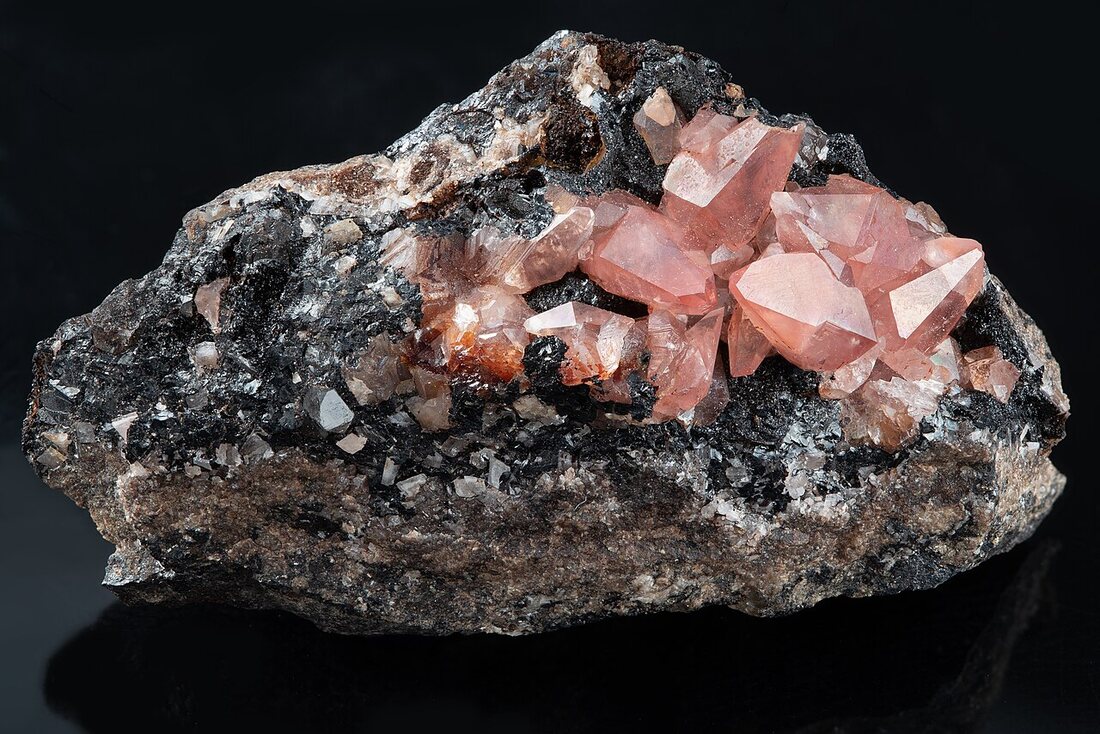
Rhodochrosite specimens are crystals of manganese carbonate (MnCO3) prized for a raspberry-to-rose-red colour found in almost no other mineral. The finest examples come from four localities that each produce a distinct look: sharp rhombohedra from Colorado, transparent cherry-red crystals from South Africa, banded stalactitic “Inca Rose” from Argentina, and pale pink rosettes from China. At Mohs 3.5–4 with perfect cleavage, every one of them is genuinely fragile.
What Is Rhodochrosite? Chemistry, Colour and Crystal System
Rhodochrosite is manganese carbonate, MnCO3, a member of the calcite group and structurally identical to calcite with manganese standing in for calcium. The name comes from the Greek rhodon (rose) and chros (colour), and the mineral rarely disappoints on that promise: fine crystals range from a pale candy pink through a saturated raspberry to a deep, almost blood-red. Iron, calcium and zinc commonly substitute for manganese in the lattice, which is why colour and clarity vary so much between localities and even within a single pocket.
Rhodochrosite crystallises in the trigonal system and, like calcite, shows a perfect rhombohedral cleavage on {10-11} — the single most important fact for anyone who owns one. Hardness sits at 3.5–4 on the Mohs scale, softer than a pocketknife blade and only marginally harder than a fingernail plus a bit. Specific gravity runs around 3.6–3.7, giving good crystals a pleasing heft that belies how easily they can be damaged. For the formal mineralogical description, chemistry and full locality list, the mindat.org rhodochrosite entry is the standard reference collectors cite.
Manganese carbonate also occurs as a bulk ore mineral in massive, banded and botryoidal habits long before it ever reaches a specimen dealer’s tray — most of the world’s rhodochrosite is mined for manganese metal, not beauty. Collector-grade material is a by-product, and often an afterthought, of that industrial mining, which is one reason supply is so tightly tied to the fortunes of a handful of specific mines rather than to rhodochrosite as a widespread commodity.
Weathering also shapes how rhodochrosite is encountered in the field. Surfaces exposed to air and moisture slowly oxidise, developing a dull grey-black crust of manganese oxide (commonly pyrolusite or related oxides) over the fresh pink-red carbonate beneath. Skilled preparators can carefully remove this crust to reveal the true colour without damaging the underlying crystal, but the process demands a light touch given the mineral’s softness — another reason why specimen preparation, not just locality, affects what a finished piece looks like on a collector’s shelf.
Crystal Habits: Rhombs, Scalenohedra and Botryoidal Growth
Three habits account for almost every rhodochrosite specimen a collector will encounter. The simple rhombohedron — a six-faced form that looks like a squashed cube — is the classic habit and the one most associated with Colorado material. The scalenohedron is a more complex, multi-faced form that produces steeper, more pointed crystals, sometimes described informally as “dogtooth” habit when the points are pronounced; South African and Chinese material frequently shows scalenohedral modification on a rhombohedral core. Botryoidal and stalactitic growth — rounded, grape-like or icicle-like masses built from countless microscopic crystals rather than one large one — dominate the Argentine material and are usually cut and polished rather than displayed as natural crystal form.
Colour zoning is common within a single crystal: a deep red core can grade outward to pale pink, or bands of manganese-rich and calcium-rich carbonate can alternate visibly, especially in sliced or polished material. Collectors should not read strong zoning as a flaw — it is simply how the mineral grew, and it is one of the features that makes a slab of banded rhodochrosite instantly recognisable.
Crystal size varies enormously by locality and habit. Sweet Home rhombohedra rarely exceed two or three centimetres on an edge, yet a handful of gemmy, undamaged centimetre-scale crystals arranged well on matrix can outvalue a much larger but duller specimen — this is a mineral where colour and transparency dominate the value equation far more than raw size. Botryoidal and stalactitic masses, by contrast, can run to tens of kilograms in a single slab, since they accumulate through slow layer-by-layer deposition in open cavities rather than through the growth of one discrete crystal.
Sweet Home Mine, Colorado: The Benchmark for American Rhodochrosite
The Sweet Home Mine, in the Alma Mining District of Park County, Colorado, is the locality against which all other rhodochrosite is measured. Originally worked for silver, the mine became famous from the 1960s onward — and especially through a dedicated specimen-mining programme in the 1990s — for pockets of deep, gemmy red rhombohedral and scalenohedral crystals perched on matrix alongside black tennantite and small quartz crystals. The single most celebrated example, nicknamed the “Alma King,” is now held by the Denver Museum of Nature and Science and remains the benchmark for what rhodochrosite can be at its absolute best.
Sweet Home material commands a premium for a simple reason: the mine is no longer in production. Specimen mining ceased in the early 2000s and the workings have since flooded, so every Sweet Home specimen on the market today is drawn from a finite pool mined decades ago. Genuine pieces typically carry old collection labels or documented provenance, and buyers should treat an “undocumented” Sweet Home attribution with caution — this is exactly the kind of claim worth verifying against a mine’s known production history, the same principle we set out in our guide to why locality matters for mineral provenance.
The mine’s specimen-mining era is well documented in the mineralogical literature: pockets were typically reached during dedicated digging campaigns rather than continuous production, so output arrived in irregular waves through the 1990s rather than as a steady stream. That intermittency is part of why Sweet Home rhodochrosite developed such a strong following among American mineral collectors specifically — each significant pocket became a known event in its own right, discussed and catalogued at the time, which in turn makes later provenance claims easier to check against the historical record.
N’Chwaning Mine, South Africa: Manganese-Field Rhodochrosite
The Kalahari Manganese Field of South Africa’s Northern Cape Province, and specifically the N’Chwaning II Mine, is the other great modern source of fine rhodochrosite. The manganese ore bodies here formed roughly 1.3 billion years ago, and a later hydrothermal event overprinted the Hotazel Formation ores, decarbonating and desilicating portions of the rock and producing an unusually rich suite of secondary minerals — rhodochrosite prominent among them.
N’Chwaning rhodochrosite tends toward a brighter, more transparent cherry-red than the deeper red of Sweet Home material, often as sharp, lustrous rhombohedra — sometimes with additional scalenohedral faces — perched on a contrasting dark matrix. Because N’Chwaning is an active manganese mine rather than a closed historic working, supply has been more consistent over the past two decades than Sweet Home’s, though fine pockets are still sporadic and unpredictable, and prices for top-tier pieces have risen accordingly as the best material is absorbed into museum and advanced private collections.
The wider Kalahari Manganese Field hosts a genuinely unusual mineral assemblage alongside rhodochrosite — manganite, hausmannite, sturmanite, andradite garnet and a long list of rare secondary species — a direct consequence of that ancient hydrothermal overprint. For collectors, this means N’Chwaning rhodochrosite is often found with, or in the same parcels as, other Kalahari specialities, and dealers who work this locality regularly tend to know the field’s mineralogy in some depth, which is worth using as a proxy for how carefully a given N’Chwaning specimen has likely been identified and graded.
Capillitas, Argentina: Banded “Inca Rose” and Stalactitic Material
The Capillitas mining district in Catamarca Province, Argentina, produces a completely different kind of rhodochrosite: banded, stalactitic and botryoidal masses built up in concentric layers of rose-red and pale pink to cream carbonate. This is the material long marketed as “Inca Rose,” a romantic name with more marketing history than literal Incan provenance — the mine’s real history is Spanish colonial and later industrial silver-lead-zinc mining, with rhodochrosite as a secondary product.
Most Capillitas rhodochrosite is cut and polished — as cabochons, bookends, spheres and sliced stalactite sections that show the banding to best effect — rather than sold as sharp natural crystals, though crystallised pockets do occur and are collected separately at a considerable premium. For anyone assembling a locality-based rhodochrosite suite alongside our guide to quartz specimen varieties, Capillitas material offers a useful contrast: a mineral valued here for pattern and colour banding rather than crystal form.
Because so much Capillitas rhodochrosite is worked into decorative and jewellery-adjacent objects — polished eggs, pyramids and cabochons are common in the tourist and gift trade around Catamarca — collectors specifically seeking natural, uncut mineral specimens need to be explicit about that preference when buying, since dealers and mine-shop stock alike are weighted heavily toward the polished ornamental end of the market rather than sharp natural crystal groups.
Wutong Mine, China: A Newer Source Already Running Low
The Wutong Mine, near Wuzhou in Guangxi Province, China, is a comparatively recent entrant to the rhodochrosite story. A modest lead-zinc-silver producer discovered in the 1950s, it began yielding notable rhodochrosite specimens to the international market in the 2000s: bladed, rosette-like crystals in a lighter pink to peach tone than either the Colorado or South African material, typically intergrown with violet fluorite cubes, pyrite and colourless micro-quartz on matrix.
Wutong’s significance for collectors is partly about aesthetics and partly about timing: the mine was placed on care and maintenance in 2011, meaning the flow of fresh specimen material has slowed to a trickle since. As with Sweet Home, that makes existing Wutong specimens a fixed and slowly diminishing pool rather than an open-ended supply, a dynamic worth understanding before assuming that “Chinese rhodochrosite” will always be an affordable entry point into the species.
When Wutong material first reached Western mineral shows in significant quantity, its combination of delicate colour, unusual bladed habit and striking violet fluorite association was, for many collectors, an entirely new look for the species — a useful reminder that rhodochrosite’s story is still being written, and that a locality most collectors had never heard of a generation ago can, within a single decade, become one of the four or five names that define how the mineral is understood.
Comparing the Major Localities
Each locality has a recognisable signature once you have seen a few examples side by side. The table below summarises the practical differences that matter most when comparing specimens across sources.
| Locality | Typical habit | Colour character | Supply situation |
|---|---|---|---|
| Sweet Home Mine, Colorado, USA | Rhombohedra and scalenohedra on quartz/tennantite matrix | Deep, saturated red, often gemmy | Closed and flooded; fixed historic supply |
| N’Chwaning II, South Africa | Sharp rhombohedra, sometimes modified | Bright, transparent cherry-red | Active mine; sporadic fine pockets |
| Capillitas, Argentina | Banded stalactitic and botryoidal masses | Rose-red to cream banding | Ongoing; mostly cut/polished material |
| Wutong Mine, China | Bladed rosettes with fluorite and pyrite | Light pink to peach | Care-and-maintenance since 2011; declining supply |
Mohs Hardness and Perfect Cleavage: Why Rhodochrosite Is Genuinely Fragile
It bears repeating because it is so easy to forget when a crystal looks robust: rhodochrosite is soft (Mohs 3.5–4) and has perfect rhombohedral cleavage, meaning it will part cleanly along flat planes under surprisingly little stress — a knock against a shelf edge, a drop of a few centimetres onto a hard surface, or even an over-firm grip can shear a crystal point or open an invisible internal fracture that later fails. This is not a mineral that forgives casual handling the way quartz (Mohs 7) or tourmaline (Mohs 7–7.5) does.
The practical upshot is that rhodochrosite specimens are usually displayed rather than handled, and serious collections store them in padded, individually compartmented boxes or fixed acrylic mounts rather than loose in drawers. We set out the general principles in our piece on how to clean and care for mineral specimens, but rhodochrosite deserves the more cautious end of every recommendation in that guide.
For context, rhodochrosite sits in similar territory to calcite and fluorite on the durability spectrum — all three are collector favourites that are nonetheless far softer and more cleavage-prone than the quartz-family minerals most people handle without a second thought. The difference with rhodochrosite is that its cleavage runs in three directions at once, rhombohedral rather than the single-direction cleavage of some other soft carbonates, so a sharp knock can shear a crystal along any of several internal planes rather than one predictable line — part of why even experienced collectors occasionally lose a fine piece to a moment’s carelessness.
A rhodochrosite specimen is not a stone you show off by passing it around the table — it is one you point to.
Handling, Cleaning and Display: A Care Checklist
Because rhodochrosite combines low hardness with perfect cleavage and, in humid climates, some sensitivity to moisture-driven surface dulling, the safest approach errs firmly on the side of minimal intervention.
| Do | Don’t |
|---|---|
| Handle by the matrix, not the crystal points | Pick a specimen up by a rhombohedron tip |
| Dust gently with a soft, dry brush | Rinse under running water or soak |
| Keep out of direct, prolonged sunlight | Use ultrasonic cleaners or steam |
| Store in a padded, compartmented box when not displayed | Stack specimens directly on top of one another |
| Display away from foot traffic and shelf edges | Apply oils, waxes or commercial “shine” products |
Ultrasonic cleaners in particular are worth calling out as an outright hazard: the vibration frequencies that safely clean quartz or amethyst can shear a rhodochrosite crystal along its cleavage planes in seconds, sometimes without any obvious external sign until the piece is lifted and a section separates in the hand.
Light and humidity deserve equal attention. Prolonged direct sunlight can, over years, subtly fade some manganese carbonates and will certainly accelerate any oxidation of exposed surfaces, while a display cabinet in a consistently humid room can promote the same dulling crust that forms on unprepared field specimens. A stable, moderate indoor environment — the kind most homes already provide away from windowsills and bathrooms — is entirely sufficient; no special humidity control is needed provided the obvious extremes are avoided.
Grading and Value: What Drives Rhodochrosite Prices
Colour saturation, crystal transparency, size, the sharpness and completeness of terminations, and freedom from damage or repair all drive value, in roughly that order of importance for most buyers. Locality matters too, both for aesthetic reasons and because some sources (Sweet Home, increasingly Wutong) are simply no longer producing. As with any collectible mineral, prices below are indicative bands rather than fixed figures — treat them as typical ranges seen across recent markets rather than a price list, since exceptional individual pieces (documented Sweet Home specimens above all) can exceed every tier shown here at auction.
| Grade tier | Typical size class | Indicative price band (USD) | Characteristics |
|---|---|---|---|
| Entry / decorative | Thumbnail to small miniature | $40–250 | Modest colour, minor damage tolerated, often Capillitas polished pieces |
| Fine | Miniature to small cabinet | $250–1,500 | Good colour and form, undamaged, clean termination |
| Premium | Cabinet | $1,500–8,000 | Strong saturated colour, sharp crystal form, notable locality |
| Museum / exhibition | Large cabinet and above | $8,000–plus, case by case | Exceptional colour, size and aesthetics; documented Sweet Home or N’Chwaning pieces frequently anchor this tier |
These bands should be read alongside the general grading framework we use across the collection, described fully in our guide to fine mineral specimen grades and applied consistently on our own grading standards page.
Buying Rhodochrosite: Repairs, Enhancement and What to Ask
Because rhodochrosite is both valuable and fragile, repaired or reconstructed specimens circulate more often than buyers expect, and it is a mineral where honest disclosure genuinely matters. Given the perfect cleavage, a chipped point can be glued back on cleanly enough to escape a casual glance, and a fractured crystal is sometimes stabilised with adhesive along an internal cleavage plane. None of this is necessarily dishonest — many dealers disclose repairs plainly — but it needs to be disclosed, and buyers should ask directly rather than assume.
| Risk | What to check | Why it matters |
|---|---|---|
| Glued or reattached points | Ask directly; examine seams under raking light or magnification | Materially affects both value and long-term stability |
| Undisclosed locality | Request documentation or provenance history | Sweet Home and other closed-mine material carries a real premium |
| Dyed or coated surfaces | Look for colour pooling in cracks and cleavage planes | Rhodochrosite is not commonly dyed, but coatings do occur on lower grades |
| Overstated grade | Compare against a published grading standard | Prevents paying premium prices for fine or entry-grade material |
Our broader guide to buying mineral specimens online covers the general red flags; with rhodochrosite specifically, the questions to ask before paying are locality documentation, an explicit statement on repairs, and — for anything claimed as Sweet Home material — some form of collection history, since that mine has been closed for two decades.
Building a Rhodochrosite Collection: Where It Fits
Rhodochrosite rewards a locality-led approach more than most species: a small, well-chosen suite of one Sweet Home rhombohedron, one N’Chwaning cherry-red crystal, one Capillitas banded slab and one Wutong rosette tells a genuinely coherent geological and market story, far more so than four similar-looking pink crystals from a single source. Because good pieces are both fragile and, for two of the four localities, no longer being produced, this is also a species where buying carefully the first time matters more than usual — condition problems are rarely fixable without disclosure, and supply for the best sources will only tighten further.
If you are assembling or expanding a broader mineral collection rather than a single specimen, our notes on starting a fine mineral collection are a useful starting point, and you can browse current rhodochrosite and related carbonate specimens directly in our specimen collection. For terminology used throughout this guide — rhombohedron, scalenohedron, botryoidal and the rest — our mineral glossary gives concise working definitions. Given how fragile fine rhodochrosite is, we would also point new buyers to how we actually get pieces to their door: see our shipping and returns page for the padding, crating and insurance standards we apply to every fragile specimen, worldwide.
For the underlying mineralogy — crystal system, hardness, associated species and a fuller locality list than we can cover here — the International Mineralogical Association maintains the reference nomenclature that dealers and museums alike defer to when a species or variety name is in question.
Frequently asked
- What is rhodochrosite?
- Rhodochrosite is manganese carbonate (MnCO3), a trigonal mineral in the calcite group prized for a raspberry-to-rose-red colour. It has a Mohs hardness of 3.5u20134 and perfect rhombohedral cleavage, making fine crystals both visually striking and genuinely fragile compared with harder collector minerals such as quartz or tourmaline.
- Where does the best rhodochrosite come from?
- Four localities dominate the fine specimen market: the closed Sweet Home Mine in Colorado (deep red rhombohedra), N'Chwaning II in South Africa (bright transparent crystals), Capillitas in Argentina (banded stalactitic 'Inca Rose'), and the Wutong Mine in China (pale pink rosettes with fluorite), now on care and maintenance.
- Is rhodochrosite expensive?
- Prices span roughly $40 for small decorative pieces to well over $8,000 for museum-grade cabinet specimens, with colour saturation, crystal transparency, size and locality driving value most. Documented Sweet Home or fine N'Chwaning pieces command the strongest premiums, and exceptional individual specimens can exceed typical bands at auction.
- Is rhodochrosite durable enough to display safely?
- Yes, with care. Rhodochrosite is soft (Mohs 3.5u20134) with perfect cleavage, so it should be displayed away from foot traffic and handled by the matrix rather than the crystal, dusted gently, and never cleaned ultrasonically. Treated this way, a fine specimen will last indefinitely on an undisturbed shelf or cabinet.
- How can I tell if a rhodochrosite specimen has been repaired or misrepresented?
- Examine crystal points and cleavage seams under raking light or magnification for glue lines, ask the dealer directly whether any repair has occurred, and request locality documentation for premium claims such as Sweet Home material, since that mine closed decades ago and provenance should be traceable.
- What is the difference between Sweet Home and Capillitas rhodochrosite?
- Sweet Home Mine in Colorado produces sharp, deep-red rhombohedral and scalenohedral crystals on matrix, now a fixed historic supply since the mine closed. Capillitas in Argentina instead produces banded, stalactitic and botryoidal 'Inca Rose' rhodochrosite, most of which is cut and polished rather than sold as natural crystal form.
- Mindat.org — mineral & locality database
- International Mineralogical Association (IMA)
- Mineralogical Society of America
Mineralogical data (species, hardness, locality) cross-referenced against Mindat and IMA records.