Quartz Specimens: A Collector’s Guide to the Major Varieties
A collector's guide to quartz specimens: amethyst, citrine, smoky and rose quartz, phantoms, scepters, Japan-law twins, rutilated quartz and Herkimer diamonds, with honest notes on treatment, care and value.
Table of contents
- What Are Quartz Specimens? Chemistry, Hardness and Why Collectors Love the Species
- The Colour Varieties: Rock Crystal, Amethyst, Citrine, Smoky, Rose and Milky Quartz
- Special Growth Forms: Phantoms, Scepters and Faden Quartz
- Japan-Law Twins: Quartz's Signature Twinning
- Included Quartz: Rutilated, Tourmalinated and Other Inclusions
- Herkimer Diamonds: New York's Doubly Terminated Quartz
- What Makes a Fine Quartz Specimen? Clarity, Termination, Form and Aesthetics
- Key Localities Worth Knowing
- Natural or Treated? Heat, Irradiation and Dyeing in the Quartz Trade
- Mohs 7 and Durability: Handling, Cleaning and Display Care
- Grading and Value: What Drives Price Across Quartz Varieties
- Building a Quartz Collection: Where It Fits
Quartz specimens are crystals of silicon dioxide (SiO2) collected in a remarkable range of guises: clear rock crystal, purple amethyst, golden citrine, brown smoky quartz, pink rose quartz, and included forms such as rutilated or tourmalinated quartz. At Mohs 7, quartz is hard and abundant, so collectors judge value mainly on form, clarity and rarity of habit — phantoms, scepters, Japan-law twins and Herkimer diamonds among the most sought after.
What Are Quartz Specimens? Chemistry, Hardness and Why Collectors Love the Species
Quartz is silicon dioxide, SiO2, crystallising in the trigonal system (trapezohedral class), and it is the defining mineral for the number seven on the Mohs hardness scale — a useful fact in itself, since it means quartz will scratch glass and most steel but is itself scratched by topaz, corundum and diamond. Specific gravity sits around 2.65, and the mineral is piezoelectric, meaning it generates a small electric charge under mechanical stress, a property that underpins its enormous industrial use in oscillators and timing circuits quite apart from its role as a collector’s mineral.
What makes quartz endlessly collectible despite being, mineralogically speaking, one of the most common substances in the Earth’s crust is the sheer variety of colour, growth habit and inclusion it can display. Few other species let a single collector build an entire, visually diverse cabinet — amethyst geodes, smoky Alpine scepters, rutilated Brazilian points, Herkimer diamonds — around one chemical formula. For the formal mineralogical description and a full locality index, the mindat.org quartz entry is the standard collector and researcher reference.
Quartz also occurs in a cryptocrystalline form — dense aggregates of microscopic crystals rather than large individual ones — which includes agate, chalcedony, jasper and chert. Those materials sit outside the scope of this guide, which focuses on macrocrystalline quartz: specimens where individual crystal faces, terminations and internal structure are visible to the naked eye or hand lens, the form that occupies most fine mineral cabinets.
Quartz’s abundance also means it is one of the few mineral species where a beginner can genuinely learn crystal geometry hands-on, at low cost, before ever moving toward rarer or more expensive material. A simple, inexpensive rock crystal point already shows the six prism faces and rhombohedral terminations that define quartz’s habit, making it a natural teaching specimen as well as a collectible in its own right — one reason quartz so often appears as the first purchase in a new collector’s cabinet.
The Colour Varieties: Rock Crystal, Amethyst, Citrine, Smoky, Rose and Milky Quartz
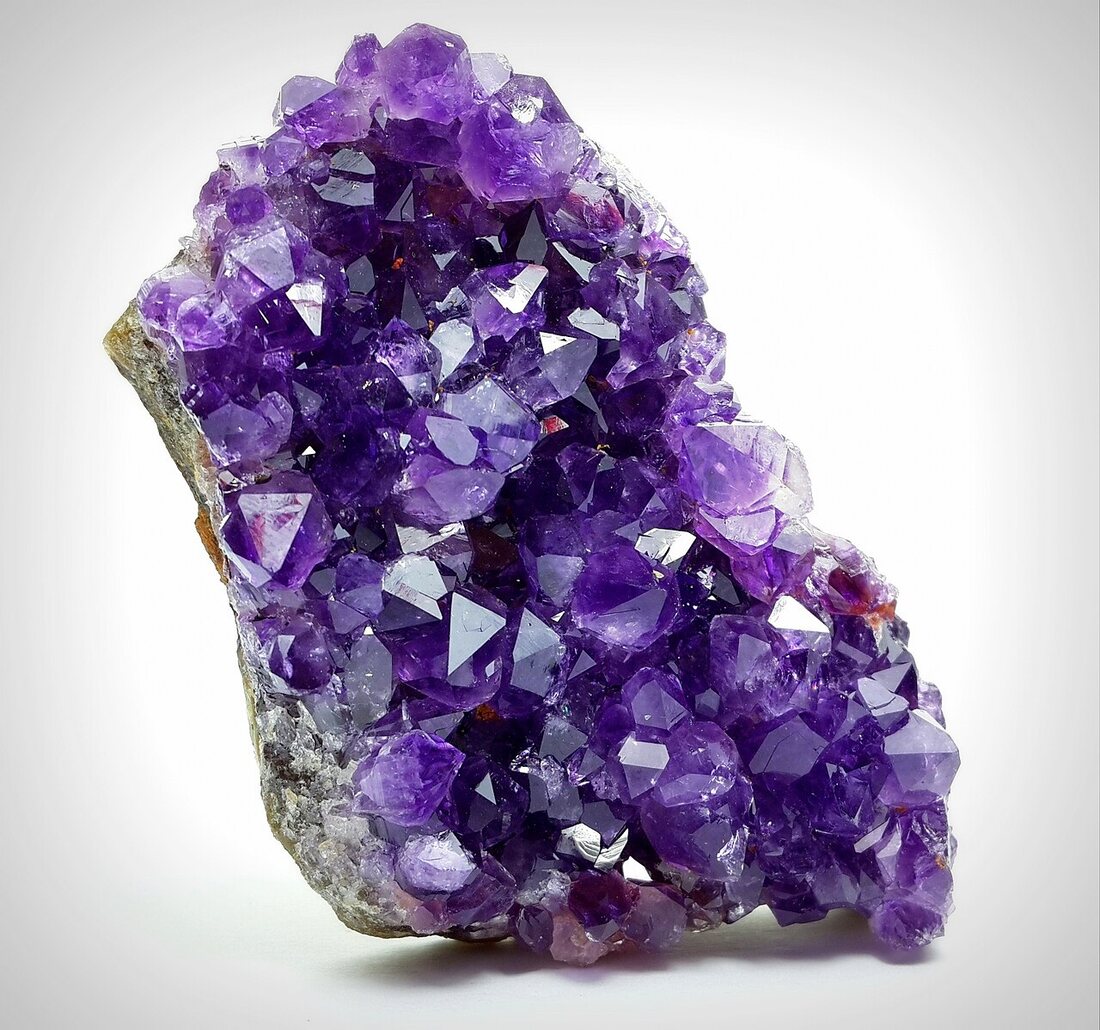
Colourless rock crystal is quartz in its purest, most common form, valued for exceptional clarity, sharp faces and unusual habits rather than colour. Amethyst owes its purple colour to trace iron impurities combined with natural irradiation, which together create colour centres in the crystal lattice; the depth of purple can vary from a pale lilac to a near-black violet, and colour is often unevenly distributed, deepest near the termination.
Citrine ranges from pale lemon-yellow to a rich orange-brown, but naturally coloured citrine is genuinely rare in nature — the great majority of citrine sold commercially is amethyst or smoky quartz that has been heat-treated, since moderate heating reliably shifts the colour centres responsible for purple or brown toward yellow and orange. This is not a secret within the trade, but it is a fact worth stating plainly, and we cover it in full in our dedicated guide to citrine specimens: natural, heated and how to tell the difference.
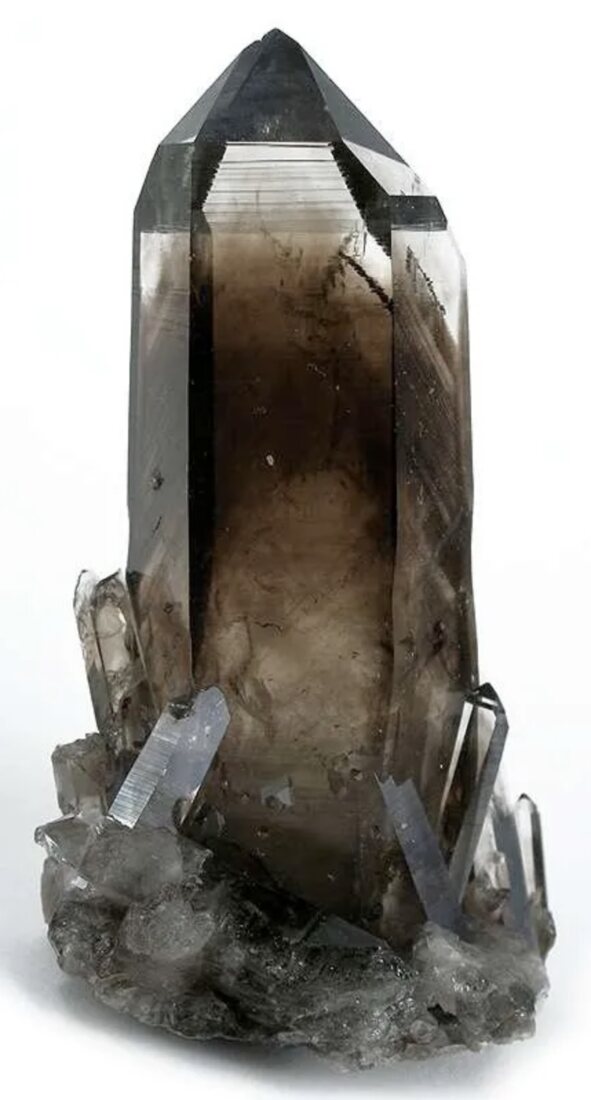
Smoky quartz gets its brown-to-black colour from natural irradiation acting on aluminium-related defects in the lattice, and is common in granite pegmatites and, especially, in Alpine-type mineral-filled fissures. Rose quartz most often occurs as massive, cloudy pink material — the colour is now generally attributed to microscopic fibrous mineral inclusions (dumortierite-group minerals) rather than a simple trace-element substitution — while well-formed crystallised rose quartz points are considerably rarer and command a real premium over the massive material found in most tumbled stones and carvings. Milky quartz, the least prized variety, owes its cloudy white appearance to abundant microscopic fluid and gas inclusions trapped during rapid crystal growth.
It is worth noting that colour in quartz is rarely permanent in a strict physical sense — amethyst can lighten with sustained heat, smoky quartz can be artificially darkened or lightened with irradiation and heat respectively, and even citrine’s orange tones can shift under prolonged strong light. None of this makes the mineral any less collectible; it simply means colour claims in quartz specifically deserve a slightly more sceptical, ask-first approach than colour claims in most other species, where the colour-causing mechanism is more fixed.
| Variety | Colour cause | Typically treated? | Relative value tier |
|---|---|---|---|
| Rock crystal | None (pure SiO2) | Rarely | Low–moderate; exceptional clarity or habit raises tier |
| Amethyst | Iron + natural irradiation | Occasionally heat-lightened | Moderate–high for deep, even colour |
| Citrine | Natural: rare trace effects; commercial: heat-treated amethyst/smoky | Very commonly heated | Low for heated; high for documented natural |
| Smoky quartz | Aluminium centres + natural irradiation | Rarely (naturally common) | Low–moderate; high for fine Alpine scepters |
| Rose quartz | Fibrous mineral inclusions (massive); trace elements debated (crystals) | Rarely | Low (massive) to high (rare crystallised points) |
| Milky quartz | Fluid/gas inclusions | Never | Low, unless unusual form |
Special Growth Forms: Phantoms, Scepters and Faden Quartz
Phantom quartz shows a ghostly outline of an earlier, smaller crystal suspended within a larger one — the result of growth being briefly interrupted, allowing a thin layer of another mineral (commonly chlorite or hematite) to settle on the crystal faces before quartz growth resumed and enclosed it. Multiple interruptions produce multiple nested phantoms, a genuinely striking effect prized by collectors interested in crystal growth history as much as aesthetics.
Scepter quartz forms when a second generation of crystal growth caps an earlier, often thinner crystal, producing a mushroom- or scepter-like head atop a narrower stem. The Goboboseb Mountains of the Brandberg area in Namibia are the classic modern locality for this habit, producing doubly terminated amethyst scepters perched on smoky quartz stems that rank among the most distinctive specimens in the entire species.
Faden quartz — from the German for “thread” — shows a fine white line running through an otherwise clear crystal, formed as the crystal repeatedly fractured and healed along a single plane while continuing to grow in an actively opening vein. Pakistan’s Baluchistan region is the best-known modern source of fine faden quartz, and the feature is essentially a visible record of the crystal’s growth stresses over time.
These three forms — phantom, scepter and faden — are collected less for size or colour than for what they reveal about how a crystal actually grew, and specimens showing two or even three of these features together (a phantom scepter, for instance) are rare enough to command real attention at any major mineral show. Sharp, well-documented examples of each are a natural complement to the colour-variety pieces most collections start with, adding a “how it formed” dimension that pure colour and size cannot.
Japan-Law Twins: Quartz’s Signature Twinning
The Japan-law twin is quartz’s most recognisable twinning law: two individual crystals grow in contact with their c-axes meeting at precisely 84.33°, producing a distinctive V-shaped or heart-shaped form with two prism faces from each individual lying parallel. The twin junction can look jagged at the surface but runs as a perfectly straight plane through the crystal’s interior. The law takes its name from early specimens associated with Japanese localities reaching European collections in the late nineteenth century, though the twinning itself has since been documented worldwide, including in Alpine and South American material.
Because the geometry is so precise and so distinctive, a genuine Japan-law twin is immediately recognisable to an experienced eye and is treated as a specialist sub-category of its own within quartz collecting — good examples, particularly with sharp, undamaged terminations on both individuals, attract dedicated collectors regardless of colour or size.
Fine Japan-law twins have been documented in amethyst as well as colourless quartz, though transparent, gemmy examples in either colour remain uncommon enough that condition takes priority over colour when evaluating one: even a modest, water-clear twin with two undamaged terminations will usually outrank a larger but chipped or incomplete example, since the entire appeal of the form rests on seeing the precise 84.33° geometry clearly on both individuals at once.
Included Quartz: Rutilated, Tourmalinated and Other Inclusions
Rutilated quartz contains needle-like inclusions of golden or silvery rutile (titanium dioxide) that can run through a crystal in a few isolated strands or as a dense, almost metallic web; Brazil’s Minas Gerais state is the best-known source of fine material, and value rises sharply with inclusion density, needle length and the crystal’s own clarity and form. Tourmalinated quartz instead contains needles of black tourmaline (schorl), also frequently sourced from Minas Gerais pegmatites, prized for the same striking contrast between transparent host and dark, wiry inclusion.
Other quartz inclusions collectors watch for include actinolite or chlorite (giving a green cast, sometimes marketed loosely as “quartz with chlorite phantom”), hematite (producing red or orange internal flashes, sometimes called “fire quartz” informally), and enhydro cavities containing trapped fluid and, occasionally, a visibly moving bubble — a feature that reliably draws attention even from non-collectors.
Herkimer Diamonds: New York’s Doubly Terminated Quartz
“Herkimer diamonds” are not diamonds at all but small, exceptionally clear, doubly terminated quartz crystals found loose within vugs in Cambrian-to-Ordovician dolostone across Herkimer County, New York, most famously at commercial digging operations such as the Herkimer Diamond Mine near Middleville. Because they grew freely within a fluid-filled cavity rather than attached to a rock wall, they terminate naturally at both ends — a genuinely different growth story from most other quartz on this list, which grows from a single attached base.
Herkimer-style crystals frequently contain petroleum or other hydrocarbon inclusions, sometimes with a visibly mobile bubble, and their combination of high transparency, sharp double termination and modest size has made them one of the most widely traded and most frequently imitated quartz varieties on the market; “Herkimer-style” material from other doubly terminated dolomite-hosted localities is sold honestly under that broader description, while true Herkimer County material commands its own premium.
Because Herkimer diamonds are small — most fall between one and three centimetres — collectors tend to focus on clarity, termination sharpness and interesting inclusions rather than size when judging quality, and a handful of exceptional pieces, whether unusually large, unusually clear, or containing a rare visible enhydro bubble, can be worth many times an ordinary example from the same locality. Digging for one’s own Herkimer diamonds at commercial pay-to-dig sites remains a popular introduction to mineral collecting for families and beginners in the north-eastern United States, which has helped keep the variety broadly known well beyond specialist collecting circles.
What Makes a Fine Quartz Specimen? Clarity, Termination, Form and Aesthetics
Because quartz is common and inexpensive at the low end, the gap between an ordinary specimen and a fine one is defined almost entirely by qualitative factors rather than rarity of the species itself. Water clarity — the absence of internal fractures, cloudiness or unwanted inclusions — matters enormously for rock crystal and lightly coloured varieties. A complete, undamaged termination matters just as much: a broken point, even skilfully repaired, drops a specimen out of the top tiers regardless of colour or size.
- Colour saturation and evenness, particularly for amethyst, citrine and smoky quartz
- Crystal termination — complete, sharp, undamaged, ideally natural rather than polished
- Habit rarity — phantoms, scepters, Japan-law twins and fine inclusions all raise interest well beyond a plain point
- Matrix association — an aesthetic cluster on natural matrix generally outperforms a single loose crystal of similar quality
- Size relative to habit — very large clear crystals are rarer than very large milky ones, so expectations shift by variety
Our broader framework for what separates a fine specimen from an ordinary one — covering all species, not just quartz — is set out in what makes a fine mineral specimen, and applies directly to how we assess quartz across the collection.
Key Localities Worth Knowing
Quartz is found on every continent, but a handful of localities repeatedly produce the material collectors specifically seek out by name.
| Locality | Known for |
|---|---|
| Minas Gerais, Brazil | Amethyst, citrine, rutilated and tourmalinated quartz, large clear clusters |
| Goboboseb / Brandberg, Namibia | Amethyst-on-smoky-quartz scepters, doubly terminated crystals |
| Southern Province, Zambia | Deep, intensely saturated amethyst |
| Swiss and Austrian Alps | Smoky quartz and scepters from Alpine-type fissures |
| Herkimer County, New York, USA | “Herkimer diamond” doubly terminated crystals |
| Arkansas, USA (Ouachita Mountains) | Large, clear rock crystal clusters |
| Madagascar | Rose quartz, smoky quartz, citrine |
Understanding why a given locality matters — beyond simple labelling — is part of building real expertise as a collector, a theme we explore more generally in why locality matters in mineral provenance; with quartz specifically, locality often signals habit and typical treatment history as much as it signals rarity.
Natural or Treated? Heat, Irradiation and Dyeing in the Quartz Trade
Quartz is, on the whole, a heavily treated group of gem and specimen materials, and honest disclosure matters more here than for almost any other mineral in a typical collection. Heat treatment is standard practice for converting amethyst or smoky quartz into commercial citrine, and is not inherently deceptive provided it is disclosed — the deception lies only in selling heated material as natural citrine without saying so. Dyeing is occasionally used to intensify or fake colour in lower-grade quartz, particularly for aggregates and druzy material sold in the decorative trade, and can usually be spotted where colour pools unnaturally in fractures or between crystal grains rather than following natural growth zoning.
Our dedicated guide on how to tell if a mineral specimen has been enhanced covers the general detection principles; for quartz specifically, the honest baseline is to assume commercial citrine is heat-treated unless proven otherwise, and to ask directly about any amethyst or smoky quartz whose colour looks unusually uniform or intense for its locality.
Mohs 7 and Durability: Handling, Cleaning and Display Care
Quartz’s Mohs 7 hardness and lack of cleavage (it breaks with a conchoidal fracture rather than along flat planes) make it one of the more forgiving minerals in a collection to handle, clean and display — a useful contrast with softer, cleavage-prone species such as rhodochrosite or calcite. That said, “forgiving” is relative, not absolute, and sharp terminations, thin scepter necks and delicate inclusions can still chip or snap under careless handling.
| Do | Don’t |
|---|---|
| Clean most quartz safely with lukewarm water and a soft brush | Assume every variety and inclusion is equally robust |
| Support clusters from underneath, not by individual points | Grip a specimen by a thin scepter neck or twin junction |
| Keep amethyst and smoky quartz out of prolonged strong sunlight | Leave coloured varieties on a sun-facing windowsill for years |
| Use ultrasonic cleaners cautiously, only on solid, inclusion-free pieces | Ultrasonically clean fractured, included or faden material |
| Store loose crystals separately to prevent point-to-point contact damage | Pile unwrapped specimens together in a drawer or box |
Prolonged, intense light exposure deserves a specific mention for amethyst: sustained heat and strong sunlight can gradually lighten or shift its colour over years, the same physical mechanism used deliberately to make citrine, simply happening slowly and unintentionally. Keeping fine amethyst specimens away from direct, all-day sun exposure preserves the colour that made the piece worth collecting in the first place.
Grading and Value: What Drives Price Across Quartz Varieties
Because quartz spans everything from common milky chunks to museum-grade Namibian scepters, price bands vary more by variety and habit than for almost any other mineral we cover. As always, treat the figures below as indicative bands drawn from typical recent markets rather than a fixed price list — exceptional pieces in any variety, especially large, undamaged, richly coloured or rare-habit specimens, regularly exceed these ranges.
| Grade tier | Typical material | Indicative price band (USD) | Characteristics |
|---|---|---|---|
| Entry / decorative | Milky quartz, small points, tumbled amethyst | $10–100 | Common habit, modest clarity or colour |
| Fine | Good rock crystal clusters, clean amethyst points, modest rutilated pieces | $100–800 | Clean termination, decent clarity or colour, no major damage |
| Premium | Fine phantoms, faden quartz, dense rutilated quartz, sharp Japan-law twins | $800–4,000 | Rare habit, strong aesthetics, excellent condition |
| Museum / exhibition | Namibian amethyst scepters, exceptional Herkimer clusters, documented rarities | $4,000–plus, case by case | Exceptional size, form, clarity or combination of rare features |
These bands sit alongside the general grading vocabulary — fine, premium and exhibition — that we apply consistently across the collection, explained fully in fine mineral specimen grades explained and detailed in full on our grading standards page.
With quartz more than almost any other species, the honest question to ask is not “is it real quartz?” but “what, if anything, has been done to it?”
Building a Quartz Collection: Where It Fits
Quartz makes an unusually good foundation for a broader mineral collection precisely because of its variety: a single case can hold a clear Arkansas cluster, a deep Zambian amethyst point, a rutilated Brazilian crystal, a Herkimer diamond and a Namibian scepter, and each tells a genuinely different geological and market story despite sharing one chemical formula. It is also a forgiving place for a new collector to start, given its relative durability and the wide spread of price points available at every quality level, a theme covered more broadly in our guide to how to start a fine mineral collection.
You can browse current quartz specimens — amethyst, citrine, smoky, rutilated and rarer growth forms — directly in our specimen collection, and our mineral glossary defines the terminology used throughout this guide, from scepter and phantom to Japan-law twin. For collectors furnishing a room rather than a cabinet, large clear or amethystine quartz clusters are also among the most popular pieces in our notes on designing interiors with mineral specimens, where scale and light transmission matter as much as rarity.
For the underlying gemmological detail on treatment detection — particularly relevant given how routinely amethyst and smoky quartz are heat-converted to citrine — the Gemological Institute of America publishes widely referenced guidance on identifying treated versus natural quartz varieties that both dealers and serious collectors consult.
Frequently asked
- What are the main types of quartz specimens?
- Collectors group quartz mainly by colour u2014 colourless rock crystal, purple amethyst, yellow-orange citrine, brown smoky quartz, pink rose quartz and cloudy milky quartz u2014 and by growth form, including phantoms, scepters, Japan-law twins, and included varieties such as rutilated or tourmalinated quartz.
- Is citrine natural or heat-treated?
- Most commercial citrine is heat-treated amethyst or smoky quartz, since moderate heating reliably shifts the colour centres responsible for purple or brown toward yellow and orange. Genuinely natural, untreated citrine exists but is comparatively rare, and reputable dealers should disclose heat treatment plainly when it applies.
- What is a Herkimer diamond?
- A Herkimer diamond is a small, highly transparent, doubly terminated quartz crystal found loose in dolostone vugs in Herkimer County, New York. Unlike most quartz, which grows attached to rock, these crystals form freely within fluid-filled cavities, terminating naturally at both ends, often with petroleum inclusions.
- What makes rutilated quartz valuable?
- Rutilated quartz contains needle-like inclusions of golden or silvery rutile within a clear quartz host, most famously from Minas Gerais, Brazil. Value rises with inclusion density, needle length, and the clarity and form of the surrounding quartz crystal, since sparse, dull inclusions are far less prized than a dense, well-defined web.
- How hard is quartz and how should I care for it?
- Quartz measures Mohs 7, hard enough to resist most scratches and relatively forgiving to handle compared with softer minerals. It should still be supported from underneath, cleaned gently with lukewarm water, kept out of prolonged strong sunlight if coloured, and stored separately to avoid point-to-point contact damage.
- What is a Japan-law twin?
- A Japan-law twin is quartz's signature twinning form, in which two crystals grow in contact with their c-axes meeting at 84.33 degrees, producing a distinctive V-shaped or heart-shaped crystal. Named after early examples from Japanese localities, the twinning is now documented worldwide and is prized as a specialist collecting category.
- Mindat.org — mineral & locality database
- International Mineralogical Association (IMA)
- Mineralogical Society of America
Mineralogical data (species, hardness, locality) cross-referenced against Mindat and IMA records.