Calcite Specimens: Crystal Forms, Twinning and Fluorescence
Calcite produces more crystal habits than any other mineral — rhombs, dogtooth scalenohedra, phantoms and Mn-activated fluorescence — but Mohs 3 hardness and perfect cleavage make careful handling essential. Here's how to identify, grade and care for calcite specimens.
Table of contents
- Calcite's Chemistry and Crystal Structure: Why Its Forms Vary So Widely
- Major Crystal Habits: Rhombohedra, Scalenohedra ("Dogtooth") and Nailhead Spar
- Twinning in Calcite: Contact Twins, Polysynthetic Lamellae and "Butterfly" Pairs
- What Causes Colour in Calcite — and What It Means for Value
- Phantom Calcite: Reading the Ghost Outlines of Earlier Growth
- UV Fluorescence in Calcite: Manganese Activation and the Red-Pink Glow
- Hardness and Cleavage: Why Calcite Demands Gentler Handling Than Quartz
- Acid Sensitivity: Why the "Vinegar Test" Should Never Touch Your Specimens
- Key Calcite Localities: Elmwood (Tennessee), Hunan (China) and Chihuahua (Mexico)
- Grading Calcite: What Separates Fine from Exhibition-Quality
- Caring for and Displaying Calcite at Home
- Buying Calcite: Price Bands, Red Flags and Questions to Ask
Calcite (CaCO₃) is a Mohs-hardness-3 carbonate with perfect rhombohedral cleavage in three directions — the two traits that explain almost everything collectors love and fear about it. No other mineral produces such a range of crystal habits, from simple rhombohedra to towering “dogtooth” scalenohedra and paper-thin twins, and manganese-bearing specimens often glow a vivid red-pink under ultraviolet light. That same softness and cleavage, though, mean calcite chips, scratches and dissolves in acid far more readily than quartz or topaz.
Calcite’s Chemistry and Crystal Structure: Why Its Forms Vary So Widely
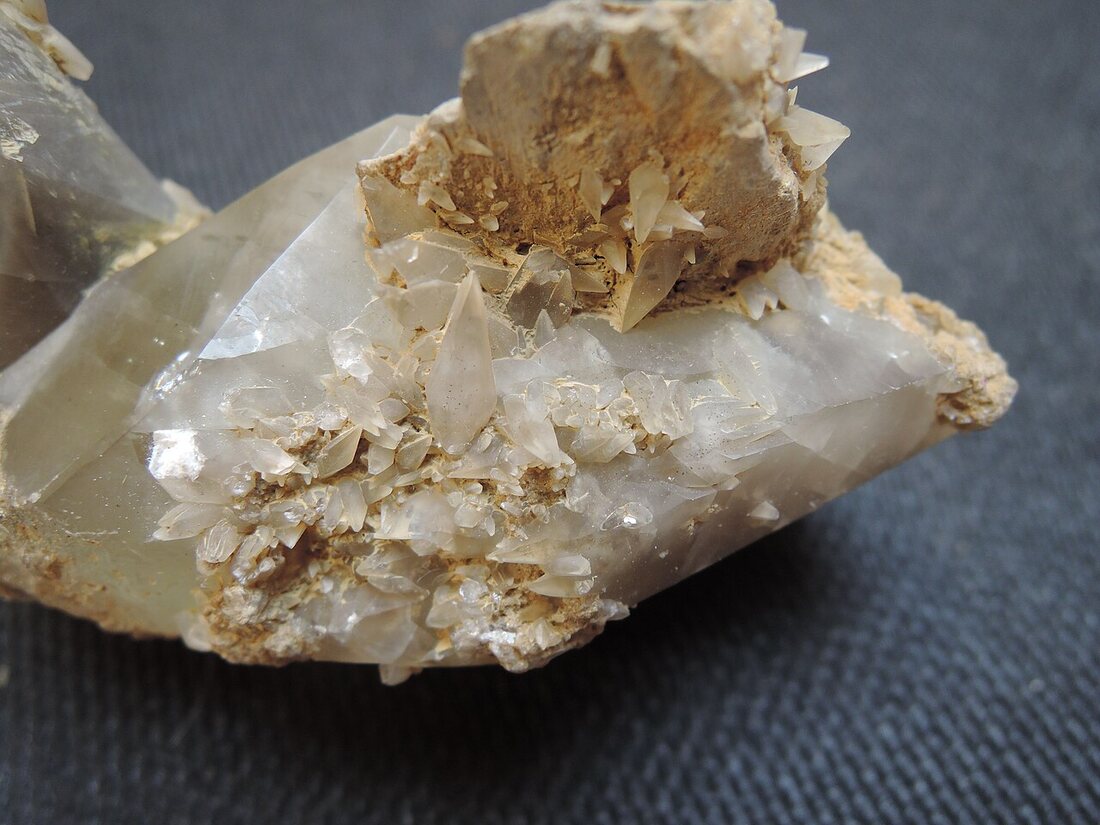
Calcite is the trigonal (rhombohedral) polymorph of calcium carbonate, CaCO₃, crystallising in space group R3̄c. It sits alongside aragonite and the rare vaterite as one of three natural CaCO₃ polymorphs, but calcite is by far the most common and the only one regularly found as large, well-formed collector crystals. Structurally, calcite is built from alternating layers of Ca²⁺ cations and planar CO₃²⁻ carbonate groups, stacked in a way that gives the whole crystal a rhombohedral symmetry even when the outward shape looks nothing like a simple rhombohedron.
That structural flexibility is exactly why calcite is famous among mineralogists for producing more distinct crystal forms than any other mineral — historic crystallography texts catalogue several hundred documented combinations of faces. The underlying unit cell barely changes, but small shifts in growth temperature, saturation, pH and trace-element chemistry favour the growth of different crystal faces at different rates, so the same mineral can emerge as a flattened tablet in one deposit and a metre-long spear-point scalenohedron in another. Calcite is also the reference mineral for hardness 3 on the Mohs scale, which every collector uses as a practical benchmark: if a specimen scratches easily with a copper coin or a fingernail (just barely, with pressure), calcite is a reasonable first guess.
It is worth remembering, too, that calcite is not a rare mineral in the geological sense — it is the principal constituent of limestone and marble, and it is precipitated biologically by countless marine organisms in shells, coral skeletons and pearl-like structures. What makes a piece collectible is not the species itself but the rarity of fine, well-terminated, undamaged crystals large enough and sharp enough to stand as specimens in their own right, which is precisely why only a small fraction of the calcite mined worldwide each year is set aside for the specimen market rather than crushed for industrial use as aggregate, cement feedstock or agricultural lime.
Major Crystal Habits: Rhombohedra, Scalenohedra (“Dogtooth”) and Nailhead Spar
New collectors are often surprised to learn that “calcite” can describe crystals that look almost nothing alike. The classic rhombohedron — the shape most people picture when they hear the word “spar” — is a leaning cube-like solid with faces meeting at oblique angles, a direct expression of the mineral’s cleavage geometry. Push the growth conditions toward elongation and you get the scalenohedron, universally nicknamed “dogtooth spar” for its sharp, canine-like points; the Elmwood Mine in Tennessee produced some of the finest dogtooth calcite ever found. “Nailhead spar” describes a different habit again: a short, stubby prism capped with a broad, flat rhombohedral or basal termination that resembles the head of an old iron nail.
Beyond these three textbook forms, calcite also grows as tabular plates, slender prisms, radiating sprays, botryoidal (grape-like) crusts, and stalactitic or “cave popcorn” masses in limestone caverns. Twinned crystals (discussed below) add still more variety. For a collector, learning to name the habit in front of you is one of the fastest ways to build real fluency in what collectors actually look for in a fine specimen.
| Habit | Description | Typical localities |
|---|---|---|
| Rhombohedron (“spar”) | Classic leaning-cube form, faces meet at ~75°/105° angles, often simple and lustrous | Cumberland, England; Iceland; many worldwide |
| Scalenohedron (“dogtooth”) | Elongated, sharply pointed crystals resembling canine teeth, often in clusters | Elmwood Mine, Tennessee; Guanajuato, Mexico |
| Nailhead spar | Short prism capped by a broad flat termination, resembling a nail head | Cumbria, England; Missouri, USA |
| Prismatic / tabular | Elongated or flattened crystals, often glassy and colourless to pale | China (Hunan, Guangxi); Mexico (Chihuahua) |
| Botryoidal / stalactitic | Grape-like crusts or cave-formed drip structures, cryptocrystalline surface | Limestone cave systems worldwide |
Twinning in Calcite: Contact Twins, Polysynthetic Lamellae and “Butterfly” Pairs
Calcite twins more readily and more visibly than almost any other common mineral, and collectors often pay a premium for well-formed twinned pieces because they read as small sculptural events rather than simple crystal growth. The most photogenic type is the contact twin, where two crystals share a single composition plane and flare outward in a V or heart shape — Chihuahua, Mexico is particularly well known for large, gemmy “butterfly twins” of this kind. Polysynthetic (lamellar) twinning is a different phenomenon: thin, repeated twin lamellae that form when a crystal is subjected to mechanical stress after it has already grown, producing a fine striped or shimmering surface pattern visible under raking light. This mechanical or “pressure” twinning is so reliably produced by squeezing calcite that it is used as a standard laboratory demonstration of stress-induced twin gliding in crystallography courses.
Penetration twins, where one crystal appears to grow through another at a defined angle, also occur, though they are rarer and usually smaller than contact twins. When you are assessing a twinned specimen, look for a crisp, undamaged contact plane and matching lustre across both individuals — a twin with a chipped junction loses much of its value precisely because that junction is the point of the piece.
Twinning is also diagnostic in the field: because calcite’s cleavage rhombohedron is never a perfect right-angled cube, a trained eye can often distinguish a genuine twin from a merely irregular crystal cluster by checking whether the reentrant angle between the two lobes matches calcite’s known twin laws. Collectors assembling a study suite sometimes deliberately seek out one example of each twin type — contact, lamellar and penetration — since side by side they demonstrate how differently the same simple chemistry can resolve itself depending on when, in a crystal’s growth history, the stress or the second nucleation event occurred.
What Causes Colour in Calcite — and What It Means for Value
Pure calcite is colourless or white, and colour in natural specimens comes almost entirely from trace-element substitution or mineral inclusions rather than from the carbonate structure itself. Small amounts of manganese (Mn²⁺) tint calcite pink to red and, critically, are also the activator responsible for red fluorescence discussed below. Iron produces yellow, brown or honey tones — the golden scalenohedra from Chihuahua, Mexico owe their warm colour largely to iron. Cobalt gives a rarer rose-red, copper produces blue or green hues, and fine dispersed carbon or bituminous inclusions can turn calcite smoky grey to jet black.
Green calcite from certain Chinese deposits, prized for its saturated apple-green colour in glassy scalenohedra, is coloured by a combination of trace transition-metal chromophores and growth-zone chemistry rather than any single agent. For buyers, colour saturation and evenness are genuine value drivers, but they should never be assessed in isolation from form, damage and lustre — our grading guide explains how Olemina weighs these factors together rather than ranking colour above everything else.
Phantom Calcite: Reading the Ghost Outlines of Earlier Growth
A “phantom” crystal preserves a faint, complete outline of an earlier growth stage inside a larger, later crystal — like a ghost silhouette suspended in clear calcite. Phantoms form when growth pauses briefly and a thin film of clay, hydrocarbon residue, or oxide dust settles over the existing crystal faces; growth then resumes, encasing that dust layer and sealing in a perfect record of the crystal’s earlier size and shape. Some calcite specimens show several nested phantoms, recording multiple growth interruptions like tree rings.
Phantom calcite is a specialty of a handful of localities, most famously Elmwood, Tennessee, where included hydrocarbons produced sharply defined amber-to-brown phantoms inside water-clear crystal terminations, and certain Chinese deposits, where fine clay dust produces softer, cloudier phantom zoning. Because the effect depends entirely on undamaged, transparent overgrowth, phantoms are also one of the more difficult features to fake convincingly, which is one reason collectors treat well-defined natural phantoms as a meaningful rarity premium rather than a cosmetic bonus.
UV Fluorescence in Calcite: Manganese Activation and the Red-Pink Glow
Many calcite specimens fluoresce because manganese (Mn²⁺), the same trace element that can tint the mineral pink in daylight, acts as a luminescence activator when it substitutes for calcium in the crystal lattice. Under longwave or shortwave ultraviolet light, Mn-activated calcite typically glows red, pink or orange, sometimes shifting in hue between the two wavelengths on the same specimen. Lead (Pb²⁺) can act as a co-activator alongside manganese, occasionally shifting the fluorescent colour toward a paler pink or blue-white. Not all calcite fluoresces — the effect depends on which trace elements were available in the growth fluid — so fluorescence is a locality-dependent bonus rather than a universal property of the species.
The single most famous fluorescent-mineral locality on Earth, Franklin and Sterling Hill in New Jersey, is not primarily a calcite locality, but its zinc-ore calcite fluoresces a strong red alongside the site’s famous green willemite and blue-white calcite. At Naica, Mexico, associated calcite and fluorite fluoresce in contrasting colours — calcite typically orange, fluorite typically deep purple — which makes paired specimens an appealing showcase piece under a UV lamp; our guide to collecting fluorite covers fluorite’s own fluorescence chemistry in more detail. A UV lamp is one of the more affordable additions to a collector’s toolkit, and it is worth testing any calcite you already own — some fluorescence is invisible in daylight and only reveals itself under a blacked-out room and a longwave/shortwave lamp.
| Locality / example | Daylight colour | Typical UV response | Notes |
|---|---|---|---|
| Franklin / Sterling Hill, New Jersey, USA | White to grey, zoned | Red (SW), sometimes zoned | Associated with fluorescent willemite and calcite in the same deposit |
| Naica Mine, Chihuahua, Mexico | Colourless to honey | Orange (paired with purple fluorite) | Popular for paired calcite–fluorite display pieces |
| Terlingua district, Texas, USA | White to colourless | Pink to red (Mn-activated) | Classic teaching locality for Mn fluorescence |
| Non-fluorescent calcite (most localities) | Variable | None or very weak | Fluorescence depends entirely on trace-element chemistry, not species |
Hardness and Cleavage: Why Calcite Demands Gentler Handling Than Quartz
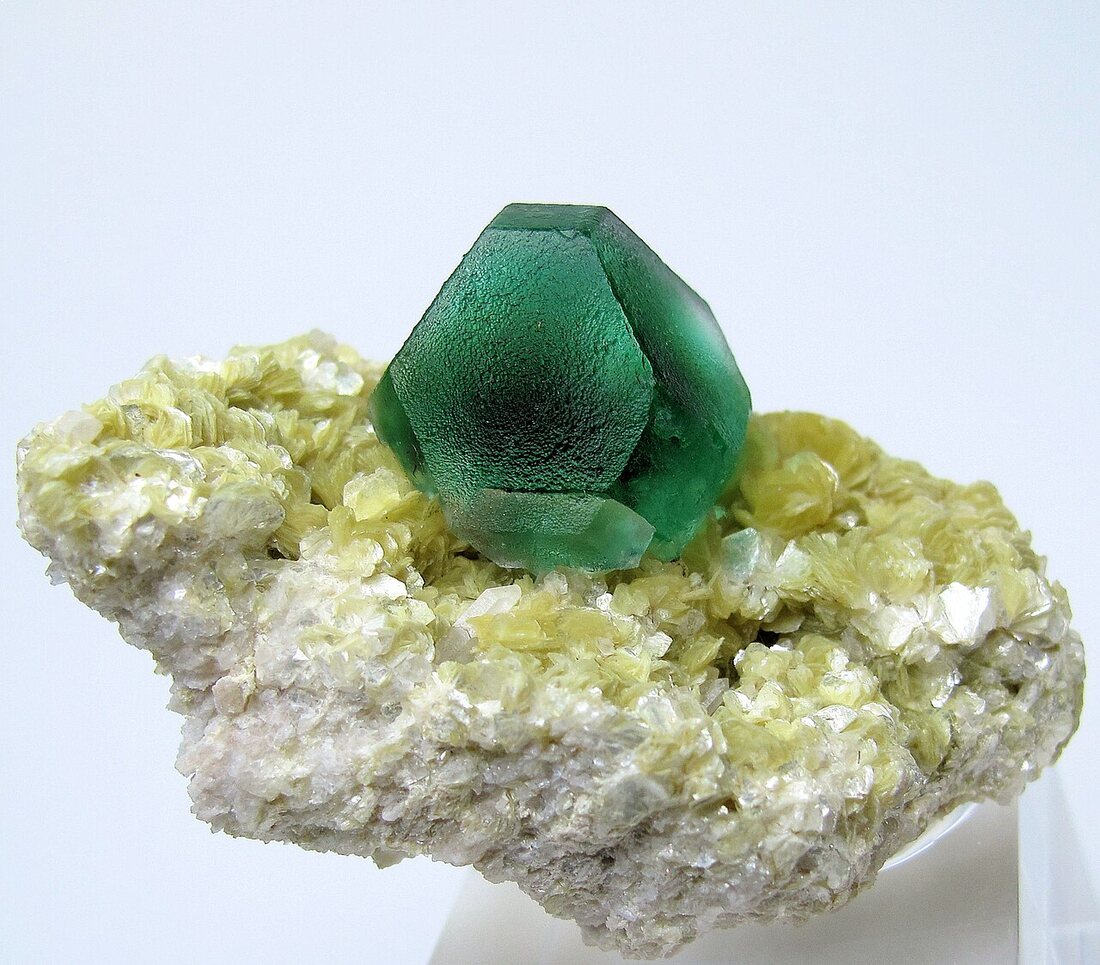
At Mohs 3, calcite is soft enough to be scratched by a steel knife blade, a coin, or even a fingernail with effort, which places it well below quartz (7) and topaz (8) on any handling-risk scale. Far more consequential than the hardness figure, though, is calcite’s perfect rhombohedral cleavage in three directions — meaning the crystal will part cleanly along three non-perpendicular planes under a comparatively light knock or a temperature shock. This is the same cleavage that makes calcite crystals so geometrically satisfying (every broken fragment is a smaller perfect rhombohedron), but it also means calcite is one of the more fragile common minerals to own, transport and clean.
Practical implications for collectors: never pick up a calcite specimen by a thin crystal point or a twin junction; always support the matrix or the broadest crystal face; avoid dropping even a few centimetres onto a hard surface; and be cautious with rapid temperature changes, such as moving a piece straight from a cold display case into direct sun or a warm car. Our full cleaning and care guide covers safe handling techniques that apply across soft, cleavable minerals generally.
Acid Sensitivity: Why the “Vinegar Test” Should Never Touch Your Specimens
Calcite is a carbonate, and every carbonate reacts with acid — this is precisely why geologists carry dilute hydrochloric acid in the field: a drop on calcite produces immediate, vigorous fizzing (effervescence) as CO₂ gas is released, while the closely related mineral dolomite only reacts when powdered or warmed. That reactivity is a useful diagnostic test on a worthless rock chip, but it is destructive on a collectible specimen — even a mild household acid such as vinegar or lemon juice will visibly etch and dull a polished calcite face within minutes, and repeated exposure will round off sharp crystal edges permanently.
A specimen that has been cleaned with acid, however briefly, cannot be returned to its original crystal-face sharpness — the etching is permanent, which is why acid testing belongs in the field on discard rock, never on a specimen you intend to keep or sell.
The same logic extends to household cleaning products more broadly: many bathroom and kitchen cleaners are mildly acidic, and calcite dust cloths, tap water with high mineral acidity, or ultrasonic jewellery cleaners (which introduce both chemical and mechanical stress) are all best avoided. A soft, dry brush and occasional distilled water rinse is the safest routine for calcite in most collections.
Key Calcite Localities: Elmwood (Tennessee), Hunan (China) and Chihuahua (Mexico)
Locality is central to calcite collecting because habit, colour and even fluorescence are strongly tied to the specific deposit a crystal grew in — a point explored more broadly in our article on why provenance matters in mineral collecting. The Elmwood Mine, Carthage, Smith County, Tennessee is arguably the most celebrated calcite locality of the twentieth century: a Mississippi Valley-type lead-zinc deposit that produced enormous, lustrous dogtooth scalenohedra, superb phantom crystals, and occasional fluorescent examples between the 1970s and the mine’s closure in the 1990s. Because active mining has ceased, genuinely fine Elmwood material is a finite, slowly diminishing supply, which underpins its continuing premium in the specialist market.
China’s Hunan province, particularly the tin-polymetallic deposits around Xianghualing, Linwu County, Chenzhou, has emerged over the past three decades as a major source of glassy, often green or colourless calcite scalenohedra and prismatic crystals, frequently associated with fluorite and cassiterite. Mexico’s Chihuahua state, including the Naica Mine and Guanajuato-area workings, is known for honey-gold to colourless calcite, dramatic contact twins, and — at Naica specifically — calcite paired with purple fluorite in a deposit famous worldwide for its giant gypsum caves.
| Locality | Typical habit / colour | Typical size range | Indicative price band* |
|---|---|---|---|
| Elmwood Mine, Tennessee, USA | Dogtooth scalenohedra, phantoms, occasional twins | Miniature to large cabinet | Moderate to high; scarce since mine closure |
| Xianghualing, Hunan, China | Glassy prismatic to scalenohedral, colourless to green | Thumbnail to cabinet | Entry-level to moderate; still actively produced |
| Naica / Chihuahua, Mexico | Honey-gold twins, paired with fluorite | Miniature to large cabinet | Moderate; premium for fine paired pieces |
Grading Calcite: What Separates Fine from Exhibition-Quality
Because calcite is soft and highly cleavable, condition weighs more heavily in its grading than it does for a hard, tough species like quartz. A fine-grade calcite specimen should show complete, undamaged terminations, minimal edge wear, and a matrix (if present) free of major bruising. Premium-grade material adds aesthetic considerations: well-balanced crystal clusters, strong colour or fluorescence, and pleasing twin geometry. Exhibition-grade calcite — the tier museums compete for — combines large size, exceptional crystal perfection, a compelling habit (a dramatic dogtooth spray, a complex phantom, or a sculptural butterfly twin), and provenance to a historically important find, ideally with old collection labels or documentation.
Because grading language varies enormously between dealers, we publish our full tier definitions and photography standards on our grading standards page, and every specimen we offer through our collection is graded against that same fixed rubric rather than marketing language unique to the listing. If you are new to grading terminology generally, our grades explained guide is a useful companion, and the house glossary defines terms like scalenohedron, phantom and contact twin in plain language.
Caring for and Displaying Calcite at Home
Calcite rewards thoughtful, gallery-style display precisely because its clarity, colour and (where present) fluorescence photograph and light beautifully, an idea we expand on when designing interiors around statement mineral pieces. A stable, padded shelf or a lined display case out of direct foot traffic is far safer than an open side table where a bag or sleeve can clip a crystal point. Keep calcite out of direct, prolonged sunlight, since some colour varieties can fade slowly with UV exposure over years, and away from heating vents or radiators, since rapid temperature swings stress the cleavage planes.
| Action | Do | Don’t |
|---|---|---|
| Cleaning | Soft dry brush; occasional lukewarm distilled water rinse, pat dry | Vinegar, lemon juice, acidic sprays, or any acid-based cleaner |
| Mechanical cleaning | Gentle hand-rinsing only | Ultrasonic cleaners — vibration can fracture cleavage planes |
| Handling | Support the matrix or broadest face with two hands | Lifting by a crystal point, edge, or twin junction |
| Environment | Stable room temperature, indirect light, padded shelf | Direct sun for long periods, heating vents, sudden cold-to-warm moves |
| Storage | Individually wrapped in acid-free tissue, separated from harder minerals | Loose in a drawer or box where harder specimens can knock against it |
Buying Calcite: Price Bands, Red Flags and Questions to Ask
Calcite spans one of the widest price ranges in mineral collecting — a small, chip-edged thumbnail from a common Chinese locality may sell for a modest sum, while a large, undamaged Elmwood dogtooth cluster with fine phantoms and old provenance can command a serious four- or five-figure price, subject as always to current market conditions. Size alone does not set price: a small, gemmy, undamaged twin with striking fluorescence can comfortably outsell a larger but dull, edge-chipped cluster, because collectors are ultimately paying for aesthetic completeness and rarity of form rather than raw bulk. Because prices are so locality- and condition-dependent, buyers should ask direct questions before purchasing: What is the confirmed locality, and is there supporting documentation? Has the piece been repaired, glued, or had any damage stabilised? Has it been cleaned with anything other than water? Does it fluoresce, and under which wavelength?
Given calcite’s fragility, shipping and returns policy matters more than it might for a tougher mineral — Olemina ships every specimen tracked and insured, with packing methods and our returns policy detailed for exactly this reason. Buyers should also be alert to the broader red flags common across online mineral sales — undisclosed repairs, vague locality claims, and stock photography rather than the actual specimen — covered in depth in our guide to avoiding fakes and overpaying. As with every species we curate, our own listings state locality, any treatment, and condition plainly, in keeping with the honestly-graded standard that defines who we are as a curator.
Frequently asked
- Is calcite a good mineral for beginner collectors?
- Yes u2014 calcite is abundant, inexpensive at entry level, and available in striking crystal forms, making it an accessible way to learn crystallography. Its main drawback is fragility: Mohs 3 hardness and perfect cleavage mean it needs gentler handling than harder minerals like quartz or topaz.
- Why does calcite glow red or pink under UV light?
- Fluorescence in calcite comes from trace manganese (Mn2+) substituting into the crystal lattice, which acts as a luminescence activator under ultraviolet light. Not all calcite fluoresces u2014 it depends on the trace-element chemistry of the specific deposit, so fluorescence is locality-specific rather than universal to the species.
- Can I clean a calcite specimen with vinegar or another acid?
- No. Calcite is calcium carbonate and reacts immediately with any acid, including household vinegar or lemon juice, etching and dulling crystal faces permanently. Clean calcite only with a soft dry brush or a brief distilled-water rinse, and avoid ultrasonic cleaners, which can fracture its cleavage planes.
- What is the difference between calcite and dolomite?
- Both are carbonates and can look similar, but calcite reacts instantly to cold dilute acid while dolomite only fizzes when powdered or warmed u2014 the classic field test. Calcite is also slightly softer (Mohs 3 versus roughly 3.5u20134) and lacks dolomite's characteristic curved, saddle-shaped crystal faces.
- Why is Elmwood Mine calcite so desirable, and can you still buy new material?
- Elmwood, Tennessee produced some of the finest dogtooth scalenohedra and phantom calcite ever found, but the mine closed in the 1990s, so no new material is being extracted. Existing specimens circulate through the secondary market, which supports Elmwood's continuing premium over actively mined localities.
- Does calcite scratch or chip easily?
- Yes. At Mohs 3, calcite can be scratched by a coin or fingernail with effort, and its perfect three-directional cleavage means a moderate knock can shear off a clean rhombohedral fragment. Always lift calcite by its matrix or broadest face, never by a crystal point or twin junction.
- Mindat.org — mineral & locality database
- International Mineralogical Association (IMA)
- Mineralogical Society of America
Mineralogical data (species, hardness, locality) cross-referenced against Mindat and IMA records.