Emerald Specimens: Beryl in Matrix and What Drives Value
Emerald specimens pair chromium-green beryl crystals with calcite, pyrite or schist matrix from Muzo, Chivor, Kagem and beyond — how locality, treatment and crystal form determine what a fine piece is worth.
Table of contents
- Emerald Specimens vs. Cut Emerald Gems: What Is the Difference?
- The Chemistry, Hardness and Fragility of Emerald, the Chromium-Green Beryl
- Muzo and Chivor: Colombia's Historic Emerald Localities
- Kagem, Zambia: The World's Largest Emerald Mine by Volume
- Panjshir, Afghanistan and the Ural Mountains: Rarer Emerald Sources
- Matrix Aesthetics: Emerald in Calcite, Pyrite and Quartz
- Oiling and Treatment: What Is Standard, and What We Disclose
- How We Grade Emerald Specimens: Colour, Clarity, Form and Damage
- Locality at a Glance: Comparing the World's Major Emerald Sources
- What Drives Value: Grade, Size and Price Bands for Emerald Specimens
- Caring for and Displaying an Emerald Specimen
- Buying an Emerald Specimen: A Collector's Checklist
Emerald specimens are natural, uncut crystals of chromium- or vanadium-coloured beryl still attached to their host rock — distinct from faceted emerald gems, which are cut from rough. Value depends on colour saturation, crystal termination, matrix aesthetics and locality, with Colombian material from Muzo and Chivor traditionally commanding the highest prices among collectors and design clients alike.
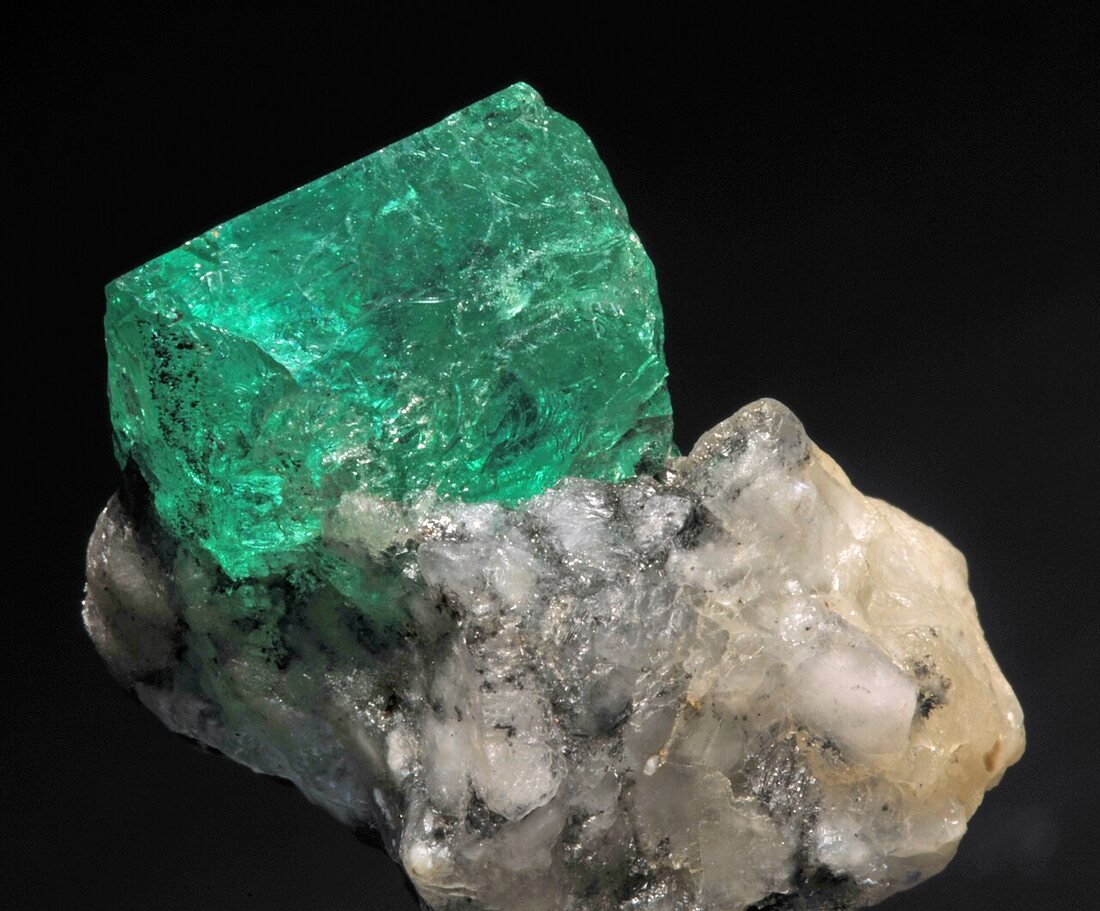
Emerald Specimens vs. Cut Emerald Gems: What Is the Difference?
Every emerald begins as the same mineral: beryl coloured green by trace chromium and/or vanadium. What happens next determines whether it becomes a jewellery stone or a collector’s specimen. A cutter chooses rough with the fewest visible fractures, orients it to maximise face-up colour, and facets away everything that isn’t gem-quality — often 70–90% of the original crystal by weight. A specimen is the opposite proposition: the crystal is left whole, ideally still seated in its natural matrix, and valued for exactly the things a lapidary would cut away — the hexagonal prism faces, the termination, the relationship between crystal and host rock.
This means the criteria diverge sharply. A cut stone is judged on brilliance, symmetry and carat weight after the fact of cutting. A specimen is judged as found: does the crystal have sharp, undamaged terminations, is the colour distributed attractively through the piece, and does the surrounding matrix — calcite, pyrite, schist or quartz — frame it well? Collectors building a cabinet around locality and form, rather than carat weight, are the primary market for emerald specimens, alongside interior designers sourcing a genuine, documented centrepiece. Anyone assembling a broader collection may also want our guide to fine mineral specimen grades, since the same Fine/Premium/Exhibition framework we use for emerald applies across the collection.
One rare specimen sub-type deserves a mention on its own: the trapiche emerald, found almost exclusively around Colombia’s Muzo district, in which black shale inclusions grow along six radiating spokes through the crystal, creating a wheel-like pattern when the crystal is cut in cross-section. Trapiche material is collected and displayed as a curiosity in its own right rather than judged by ordinary clarity standards, and genuine examples — as opposed to assembled or reconstructed lookalikes — carry a meaningful premium precisely because the growth mechanism behind the pattern is still debated among mineralogists.
The Chemistry, Hardness and Fragility of Emerald, the Chromium-Green Beryl
Emerald is the green variety of the mineral beryl, a beryllium aluminium cyclosilicate with the formula Be₃Al₂(SiO₃)₆, crystallising in the hexagonal system. Its defining green colour comes from trace amounts of chromium and/or vanadium substituting for aluminium in the crystal lattice; iron, present in smaller amounts, shifts the tone slightly toward blue or yellow depending on the deposit. Full technical data, including crystal habit and optical properties recorded across thousands of localities, is catalogued on mindat.org’s emerald entry.
On the Mohs scale, emerald rates 7.5–8, which sounds reassuringly hard — harder than a steel knife blade, comparable to other beryls like aquamarine. In practice, emerald behaves as one of the more fragile gem species collectors handle. Almost every natural emerald grows with internal fractures and multi-phase inclusions, poetically termed the jardin (“garden”) by the trade. These inclusions relieve internal stress unevenly, so a crystal that resists a scratch test can still fracture from a moderate knock, a temperature shock, or even ultrasonic vibration. Hardness measures resistance to abrasion, not toughness, and emerald is a textbook case of the two properties diverging. This is precisely why our grading standards weigh visible fracture risk separately from surface hardness when we assess a piece for sale.
Optically, emerald has a refractive index of roughly 1.577–1.583 and weak birefringence, with a specific gravity around 2.76 — all consistent with the wider beryl group. One lesser-known diagnostic worth knowing: under longwave ultraviolet light, some Colombian emerald shows a faint red fluorescence from its chromium content, while higher-iron material from Zambia and most African deposits typically shows none, since iron quenches the effect. It is a useful supporting clue, though never a substitute for proper origin documentation, when comparing crystals of uncertain source.
Muzo and Chivor: Colombia’s Historic Emerald Localities
Colombia’s emerald belt, roughly 100km wide along the eastern Cordillera Real northeast of Bogotá, contains close to 200 recorded localities, but two names dominate collector demand: Muzo and Chivor, both in Boyacá Department. Their geology is genuinely unusual. Unlike almost every other emerald deposit on earth, Colombian emerald formed with no igneous or pegmatitic input at all — hydrothermal fluids moved through Cretaceous-age, organic-rich black shale and interacted with evaporite minerals, precipitating emerald alongside calcite, dolomite, albite, pyrite and, occasionally, parisite. Mining at Muzo predates the Spanish conquest, worked first by the Muisca people, and the mine remains one of the most productive emerald sources in the world for both gem rough and matrix specimens.
Muzo material tends toward a deep, slightly warm green with a whisper of yellow; Chivor, roughly 90km to the northeast and the only privately owned emerald mine in Colombia, more often yields a cooler, bluer green often described by dealers as “pure.” Both localities are prized above all for specimens where hexagonal emerald crystals sit in pale calcite matrix, sometimes with brassy pyrite crystals scattered nearby — an aesthetic combination that has no real equivalent elsewhere. Because locality and provenance carry so much weight in emerald pricing specifically, documentation of mine of origin is one of the first things we verify before a Colombian piece enters our collection.
Extraction methods vary widely across the belt. Larger operations run bench-and-terrace mining with heavy machinery to expose the productive shale layers, while independent guaqueros traditionally sift through washed-down waste rock after rains, occasionally turning up crystals missed by the primary operation. Neighbouring mines such as Coscuez and La Pita, also in Boyacá, produce material similar in character to Muzo and are sometimes marketed under the broader “Colombian” label when the specific mine of origin cannot be confirmed — one more reason we treat locality claims for this species with particular care.
Kagem, Zambia: The World’s Largest Emerald Mine by Volume
Zambia’s Kafubu emerald field, in the Copperbelt’s Lufwanyama District, hosts the Kagem mine, now the largest single emerald producer on earth by carat volume. The geology here follows the more typical global pattern for emerald: beryllium-bearing pegmatitic and hydrothermal fluids, dating to the Pan-African orogeny roughly 530 million years ago, reacted with chromium-rich ultramafic rock to form emerald within talc-mica schist. That schist context matters for specimen collectors — Zambian material rarely offers the pale calcite backdrop that makes Colombian pieces so photogenic, since the host rock itself is a dark, foliated grey-green.
What Kagem delivers instead is remarkably consistent colour and clarity at scale: a cooler, bluer green, often with fewer visible inclusions than comparable Colombian rough, produced under large-scale, well-documented mining rather than artisanal extraction. For specimen collectors this translates into well-formed terminated crystals in schist matrix — less classically “pretty” than a Muzo piece, but geologically legitimate and increasingly sought after as buyers diversify beyond Colombia. Kagem’s majority owner, the mining group Gemfields, sells the bulk of its production as graded rough through periodic international auctions in hubs such as Singapore and Jaipur; only a small fraction is set aside as aesthetic crystal specimens before the auction lots are formed, which is one reason well-documented Zambian matrix pieces are less common on the specimen market than the sheer scale of the mine might suggest.
Panjshir, Afghanistan and the Ural Mountains: Rarer Emerald Sources
Two further localities appear often enough in serious collections to merit attention, though neither offers the volume or consistency of Colombia or Zambia. Afghanistan’s Panjshir Valley, northeast of Kabul, produces emerald in quartz-carbonate hydrothermal veins cutting black schist — a formation broadly similar in spirit to the Colombian model, though geologically distinct in detail. Mining has historically been small-scale and artisanal, and decades of regional instability have made the supply chain inconsistent; specimens do reach the market, typically showing emerald in white quartz matrix, but buyers should expect gaps in documented chain of custody more often than with Colombian or Zambian material.
Russia’s Ural Mountains, specifically the historic Malysheva deposit near Yekaterinburg (formerly the Sverdlovsk emerald mines), have produced emerald since their discovery in 1830, hosted in mica schist adjacent to pegmatite intrusions — the same district, notably, that yields fine phenakite and the colour-change mineral alexandrite. Ural emerald specimens are less commonly offered today; historic pieces occasionally surface at auction and carry a premium for rarity and mining history rather than for colour intensity, which tends to be more subdued and yellowish-green than either Colombian or Zambian material.
A handful of secondary localities round out a well-travelled emerald cabinet. Brazil’s Santa Terezinha de Goiás deposit produces schist-hosted crystals broadly comparable in geology to the Zambian type, while Austria’s historic Habachtal locality, largely exhausted today, remains significant for nineteenth-century museum material. More recently, Ethiopia’s Shakiso district has emerged since the mid-2010s as a fast-growing source of good colour and clarity, and is increasingly discussed alongside Zambia as a modern alternative to Colombian material for both cut stones and specimens.
Matrix Aesthetics: Emerald in Calcite, Pyrite and Quartz
For specimen collectors, the matrix is not packaging — it is half the object. Four host-rock contexts recur across the major localities, each with a distinct visual character:
- Calcite matrix (classically Colombian): cream to white calcite, sometimes threaded with dark shale, provides the strongest colour contrast against green crystal faces and is generally the most sought-after presentation.
- Pyrite association: brassy, metallic pyrite cubes or masses growing alongside emerald, common in Muzo material, add textural and lustre contrast without competing with the green.
- Quartz matrix: milky or clear quartz, more typical of Panjshir and some Ural material, offers a paler, quieter backdrop than calcite.
- Schist matrix: dark grey-green foliated rock, typical of Zambian and Ural material, is the least commercially prized aesthetic but the most geologically informative, showing the crystal in genuine metamorphic context.
A well-formed crystal on an unattractive matrix can still be a fine mineralogical specimen; a mediocre crystal on spectacular calcite with pyrite can outsell it. Both attributes are assessed independently in our own listings, and the distinction is explained further in the glossary entry on matrix versus host rock.
Oiling and Treatment: What Is Standard, and What We Disclose
Emerald treatment is not a modern invention. Filling surface-reaching fractures with oil to improve apparent clarity is documented back to antiquity — cedar oil, and more recently synthetic resins such as Opticon or ExCel, remain the trade standard for cut emerald gems, to the point that an untreated faceted emerald is genuinely unusual and commands a premium when certified as such. Independent laboratories including GIA grade treatment on a scale from none through minor, moderate and significant, and disclose it on every report; see GIA’s emerald reference for how the trade defines these tiers.
Specimens are a different case. Because a crystal on matrix is bought for form and locality rather than faceted clarity, oiling is far less universal — but it does happen, usually to deepen surface colour or fill a shallow fracture before photography or sale. This is exactly the kind of enhancement our guide to detecting treated specimens covers in more technical depth.
We would always rather tell a client that a piece has been lightly oiled and let them decide, than have them discover it themselves a year later. Honestly graded has to mean something on every species, not just the durable ones.
Every emerald specimen we sell states plainly whether it has been oiled, resin-treated, or left entirely natural, in line with the same disclosure standard set out on our grading standards page.
How We Grade Emerald Specimens: Colour, Clarity, Form and Damage
Grading an emerald specimen draws on the same framework we apply across the collection — Fine, Premium and Exhibition — but weighted for what actually matters in this species. Colour saturation and hue come first: a vivid, evenly distributed green outweighs a paler but “cleaner” crystal, since visible jardin is expected and rarely penalised the way inclusions would be in, say, a quartz specimen. Crystal form matters nearly as much — sharp, complete hexagonal termination against a broken or bruised crystal face is often the single biggest swing factor in price. Size, naturally, scales value, though a small crystal with exceptional colour and form on striking matrix regularly outsells a larger, duller one. It helps to remember that gemmological labs classify emerald as a “Type III” species for clarity purposes, meaning visible inclusions are expected and normal even in top-quality material — a standard we apply to specimens as much as to cut stones, rather than penalising a piece for the jardin that defines the species.
Damage assessment on emerald specifically has to distinguish natural internal fracturing (part of the species, not a defect) from mechanical damage incurred during extraction, cleaning or shipping — chipped edges, snapped terminations, or fresh conchoidal fractures with none of the weathering a natural fracture surface would show. Matrix aesthetics and treatment disclosure round out the assessment. Collectors wanting the full mechanics of this process can read our dedicated explainer on how specimen grades are defined.
Locality at a Glance: Comparing the World’s Major Emerald Sources
The table below summarises how the five localities discussed above differ in formation, typical colour and specimen character — useful shorthand when comparing pieces from different sources side by side.
| Locality | Typical Matrix / Host | Characteristic Colour | Specimen Notes |
|---|---|---|---|
| Muzo, Colombia | White to cream calcite, shale, pyrite | Deep green, slightly warm | Classic calcite-matrix aesthetic; historic locality since pre-Columbian mining |
| Chivor, Colombia | Calcite, albite, pyrite | Cooler, “pure” green | Only privately owned Colombian mine; source of the famed 630-carat “Patrizius” |
| Kagem, Zambia | Talc-mica schist | Bluer green, often high clarity | Largest producer by volume; consistent, well-documented supply chain |
| Panjshir, Afghanistan | Quartz-carbonate veins in schist | Medium to deep green | Artisanal mining; supply and documentation less consistent |
| Ural Mountains, Russia | Mica schist near pegmatite | Subdued, yellowish-green | Historic locality since 1830; scarce on today’s market |
What Drives Value: Grade, Size and Price Bands for Emerald Specimens
Price for an emerald specimen compounds several variables at once — colour, form, matrix, size, locality and treatment status — which is why two crystals of similar carat weight can differ in price by a factor of ten. As a general, necessarily hedged guide to where recent markets have tended to sit:
| Grade Tier | Typical Description | Indicative Price Range* |
|---|---|---|
| Fine | Thumbnail-sized crystal, moderate colour, visible jardin, minor edge wear, modest or no matrix | $150 – $800 |
| Premium | Miniature to small cabinet size, good saturated colour, largely intact termination, attractive calcite or schist matrix | $800 – $4,000 |
| Exhibition | Cabinet-sized, vivid and even colour, sharp complete termination, striking matrix presentation, minimal treatment | $4,000 – $18,000 |
| Museum-documented | Rare form, exceptional size or historic provenance (e.g. named Colombian mine, pre-1960s Ural material) | $20,000+ |
These bands are directional, not a price list — a superb small crystal will always outperform a dull large one, and locality alone can shift a piece up or down a full tier. Buyers assembling a collection around long-term value, rather than decorative appeal alone, may also want our separate analysis of whether fine mineral specimens are a good investment, which addresses emerald specifically among several benchmark species.
Caring for and Displaying an Emerald Specimen
Emerald’s combination of high nominal hardness and genuine internal fragility means the care routine differs from harder, cleaner species. The table below sets out the core do’s and don’ts.
| Situation | Do | Avoid |
|---|---|---|
| Cleaning | Dust gently with a soft brush; wipe with a barely damp soft cloth if needed | Ultrasonic or steam cleaners, which can propagate internal fractures |
| Light exposure | Indirect, filtered daylight or LED display lighting | Prolonged direct sun, which can dry oil treatments and fade some tones over years |
| Handling | Hold by the matrix; support the crystal rather than gripping it | Picking the piece up by an exposed termination |
| Temperature | Stable room temperature away from vents and windows | Sudden heat or cold shock, e.g. near a radiator or in a hot car |
| Storage | Padded tray or box, crystal faces unobstructed and unstacked | Wrapping tightly in tissue that touches and can abrade crystal faces |
Displayed sensibly — away from direct sun and vibration, in a stable cabinet — a well-chosen emerald specimen is a genuinely long-lived object; several pieces in circulation among collectors today were extracted more than a century ago, having simply been kept out of harsh light and handled with reasonable care from one owner to the next. A single well-lit cabinet position, chosen once and left alone, does more for the long-term condition of an emerald specimen than any amount of occasional careful handling elsewhere in the room.
Buying an Emerald Specimen: A Collector’s Checklist
Before committing to a piece, we suggest working through the following:
- Is the locality documented, and does it match the matrix and colour typical of that source?
- Is any oiling, resin treatment or stabilisation disclosed in writing, not just implied by a glossy appearance?
- Are the crystal terminations complete, or is damage described honestly rather than photographed to minimise it?
- Does the matrix genuinely enhance the piece, or is it incidental rock that adds bulk without aesthetic value?
- Is the price broadly consistent with the grade tier the piece is being sold at, given colour, size and locality together?
- Does the piece come with a written description and, for higher-value purchases, is it suitable for scheduling on a household or specialist insurance policy?
It is also worth confirming, before buying, that a seller will state plainly which household cleaning products to avoid — chlorine-based bleaches and general jewellery-cleaning solutions can react with or dissolve oil and resin fillings over time, which is a common and avoidable cause of a specimen looking noticeably duller a few years after purchase. An emerald specimen bought well — documented, honestly graded, and matched to your existing cabinet or interior — tends to hold both its beauty and its value far better than one bought on colour photography alone. Our full current range, updated as new material is graded, is browsable in the specimens collection, and pieces suited to milestone gifts or client presentations are also flagged separately for corporate gifting enquiries.
Frequently asked
- What is the difference between an emerald specimen and a cut emerald?
- An emerald specimen is a natural, uncut crystal, often left on its matrix, valued for form, colour and locality. A cut emerald is fashioned into a faceted gem for jewellery, with most of the original crystal removed in the process. Specimens preserve crystallography and provenance that cutting destroys.
- Are emerald specimens oiled or treated like cut emerald gems?
- Cut emeralds are almost universally oiled to mask fractures, a practice dating to antiquity. Specimens are treated less often, but some dealers lightly oil exposed crystal faces to enhance colour for display. Reputable sellers disclose this in writing rather than leaving it to be discovered later.
- Which locality produces the finest emerald specimens?
- Colombia's Muzo and Chivor mines are historically regarded as finest for crystal specimens, prized for saturated colour and calcite matrix. Zambia's Kagem mine produces excellent colour and clarity too, typically in less photogenic schist matrix, at much greater and more consistent volume.
- Why is emerald so easily damaged despite its Mohs hardness of 7.5-8?
- Emerald's hardness resists scratching, but the species is unusually included and internally stressed, a feature dealers call the jardin. A hard knock, sudden temperature change or ultrasonic cleaning can fracture a crystal that would otherwise easily resist abrasion from harder or softer materials.
- How much does a fine emerald specimen cost?
- As of recent markets, prices span roughly $150 for a small, included thumbnail-sized crystal to $15,000 or more for a cabinet-sized, vividly coloured Colombian crystal with sharp termination and attractive calcite matrix. Exceptional, well-documented museum-grade pieces can exceed $20,000.
- Can I display an emerald specimen in direct sunlight?
- We don't recommend it. Prolonged UV and heat exposure can dry out any oil treatment, dull surface lustre and, over years, stress existing internal fractures further. A cabinet with filtered, indirect light, away from direct sun and heat sources such as radiators, is safer for long-term display.
- Mindat.org — mineral & locality database
- International Mineralogical Association (IMA)
- Mineralogical Society of America
Mineralogical data (species, hardness, locality) cross-referenced against Mindat and IMA records.