Selenite and Gypsum Specimens: Handling, Cleaning and Care
Selenite specimens are gypsum at Mohs hardness 2, water-soluble and perfectly cleavable, so a single wash can etch or crack them. Here is how to clean, handle, mount and display them safely.
Table of contents
- What Is Selenite? Understanding the Gypsum Family
- The Gypsum Varieties: Selenite, Satin Spar, Desert Rose, Gypsum Flowers and Alabaster
- Why Gypsum Is So Fragile: Hardness, Cleavage and Solubility
- The Naica Giants: What the World's Largest Crystals Reveal About Care
- The Golden Rule: Never Wash Selenite
- Safe Cleaning Methods That Won't Damage the Surface
- Handling Selenite and Gypsum Specimens Correctly
- Mounting, Stands and Safe Display
- Humidity, Temperature and Light in the Display Environment
- Gypsum Varieties Compared
- A Care Do's and Don'ts Matrix for Selenite
- What Affects Value and Grade in Selenite Specimens
Never wash a selenite specimen: gypsum (CaSO4·2H2O) is water-soluble, only Mohs hardness 2, and splits along a perfect cleavage plane, so water, ultrasonic cleaners and rough handling all risk permanent damage. Dust dry, with a soft brush or blower, support pieces from the base, and keep them out of direct sun and sudden humidity swings. That is the core of safe selenite care.

What Is Selenite? Understanding the Gypsum Family
Selenite is the clear-to-translucent, well-crystallised variety of gypsum, a calcium sulfate dihydrate with the formula CaSO4·2H2O. On mindat’s reference entry for gypsum, the species is described as the most common sulphate mineral on Earth, occurring as massive rock (including the carvable alabaster variety), as parallel fibrous aggregates (satin spar), and as the clear, glassy crystals collectors know as selenite. All of these are the same mineral species, chemically identical, differing only in how the crystals grew and how light passes through them.
What makes selenite distinctive to the eye is its combination of transparency and a soft, pearly-to-vitreous lustre on cleavage faces, sometimes with a faint golden or honey tint from trace impurities, though the purest material is water-clear. Crystals can form as flat blades, tabular plates, or the swallowtail twins characteristic of gypsum growing in evaporite and cave settings. Because gypsum crystallises readily and quickly from saturated solutions, well-formed selenite specimens are relatively abundant compared with many collectible species — the challenge for a collector is less about scarcity and more about finding pieces that have survived handling and transport undamaged, which is the throughline of everything in this guide.
New collectors sometimes confuse selenite with clear quartz points, since both can appear as glassy, colourless crystals, but the two are easy to separate once you know what to feel for. Quartz, at Mohs hardness 7, resists a fingernail scratch entirely and has no obvious cleavage, breaking instead with a curved, glass-like conchoidal fracture. Selenite scratches under a fingernail with almost no pressure and, if you look closely along a broken edge, shows the flat, step-like faces of its cleavage rather than a smooth curve. Our broader guide to quartz specimen varieties is a useful companion if you are trying to place selenite correctly against the harder, more familiar species most collections start with.
The Gypsum Varieties: Selenite, Satin Spar, Desert Rose, Gypsum Flowers and Alabaster
Gypsum’s varieties look different enough from one another that beginning collectors are often surprised they share a single mineral identity. Selenite refers to clear, glassy crystals and cleavage plates, the form most associated with the name and with dramatic large-crystal localities. Satin spar is a fibrous, parallel-growth variety with a silky, chatoyant sheen when cut across the fibres, commonly white or pale pink and popular for polished slabs and carved shapes. Desert rose forms as rosette-shaped clusters of thin, curved gypsum (or, less often, barite) plates that trap sand grains as they grow, giving a distinctive tan, gritty texture entirely unlike clear selenite. Gypsum flowers are curling, twisted fibrous formations found in caves, where capillary action draws mineral-saturated water slowly through rock and deposits gypsum in delicate, ribbon-like curls. Alabaster, finally, is a fine-grained, massive variety long used for carving, historically in Egypt and, since antiquity, around Volterra in Italy.
Each variety inherits gypsum’s fundamental physical properties — the same hardness, the same cleavage, the same water solubility — so the care principles in this guide apply across the whole family, even though a fibrous satin spar carving and a metre-long transparent selenite blade look nothing alike. Collectors moving between varieties for the first time sometimes assume that a duller, sandier desert rose is tougher than glassy selenite because it looks more like ordinary rock; it is not, and it deserves the same caution.
Why Gypsum Is So Fragile: Hardness, Cleavage and Solubility
Gypsum sits at exactly Mohs hardness 2 — it is, in fact, the reference mineral that defines that point on the ten-step scale used throughout mineralogy and described by learned societies such as the Mineralogical Society of America, meaning it can be scratched by a fingernail (roughly hardness 2.5) with only slight pressure. That alone makes it one of the softest minerals regularly sold as a display specimen, softer than talc-adjacent softness in practical terms, and it means dust, grit or even a careless thumbnail can leave a visible mark on a polished or cleaved face.
Cleavage compounds the problem. Gypsum has a perfect cleavage in one direction, described crystallographically as the {010} plane, which splits the crystal into thin, flexible-but-inelastic sheets — press on them and they will crack rather than spring back. Two further, less perfect cleavage directions mean a selenite blade can shear along several planes if struck or flexed, which is why large plates and blades so often arrive with hairline internal cleavage cracks even when they otherwise look undamaged. Finally, gypsum is moderately water-soluble: roughly 2.0–2.5 grams will dissolve into a litre of water at room temperature, a small but real number that means water is not a neutral cleaning agent for this species the way it is for quartz or calcite. Warm water dissolves gypsum faster than cold, and repeated wetting — even brief, well-intentioned dusting with a damp cloth — will, over months and years, dull sharp edges and etch bright cleavage faces.
The Naica Giants: What the World’s Largest Crystals Reveal About Care
The single best illustration of gypsum’s relationship with temperature, water and time comes from the Naica Mine in Chihuahua, Mexico, home to the Cueva de los Cristales, or Cave of Crystals, discovered in 2000 roughly 300 metres below the surface. The cave’s selenite crystals, documented on mindat, are the largest natural gypsum crystals ever recorded, some exceeding 11 metres in length and weighing an estimated 55 tonnes. They grew because a magmatic body roughly 4–5 kilometres beneath Naica kept the local groundwater at a remarkably stable 54–58°C for several hundred thousand years — a temperature range that sits right at the narrow boundary where gypsum, rather than its dehydrated relative anhydrite, is the stable phase in solution. Slow, uninterrupted growth at that stable temperature, submerged the entire time, is what allowed crystals of that scale to form at all.
The lesson for a collector’s cabinet is almost the mirror image of Naica’s formation story: the giant crystals grew because conditions never changed for hundreds of millennia, and they are correspondingly vulnerable now that conditions have changed. Once brought to the surface, exposed to air and swinging temperatures, gypsum crystals — Naica’s included — begin to dehydrate and degrade far faster than they ever grew, which is exactly why the cave itself has been sealed and is not open to casual visits. A far smaller selenite specimen on a shelf faces the same basic physics: stability, not intervention, is what keeps it intact.
The Golden Rule: Never Wash Selenite
If you take one rule from this guide, make it this one: do not wash, soak, or run water over selenite or any other gypsum specimen. Because gypsum is measurably soluble in water, even a quick rinse under a tap can dull a polished face, soften sharp crystal edges, and leave a faintly etched, frosted appearance that cannot be reversed by drying the piece off afterward — the material that gave the surface its sharpness has actually dissolved and washed away. Ultrasonic cleaners, steam cleaners and ordinary jewellery-cleaning solutions are all similarly unsuitable, since they combine water with vibration, heat or chemicals that accelerate the same damage.
This is a meaningful departure from the “give it a wash” instinct that works reasonably well for hard, insoluble species such as quartz or fluorite, and it is the single most common way we see gypsum specimens damaged after they leave a mine and before they reach a considered collection. If a piece is genuinely dirty rather than merely dusty, the safer approach is a barely damp — not wet — soft cloth used sparingly on a small test area first, and only on sturdy, undamaged material; for anything with visible cleavage cracks, fine points, or sand-textured surfaces such as a desert rose, skip liquid entirely and use the dry methods below instead.
Honestly graded means saying it plainly: if a selenite piece has been near water at any point in its life, we would rather tell you and show you where, than let a bright photograph speak for a surface that has already been softened.
Safe Cleaning Methods That Won’t Damage the Surface
Routine dust is best removed with a soft, dry artist’s brush or a rubber blower bulb of the kind used for camera lenses, working gently from the base of a crystal cluster outward and never dragging bristles across a thin, unsupported blade tip. Compressed air can work for hard-to-reach crevices in a cluster, but should be used in short bursts at a distance, since a full-strength blast can snap fragile terminations just as easily as a dropped cloth. For fingerprints or light grime on a robust, undamaged selenite face, a barely damp microfibre cloth — wrung out until it feels almost dry — followed immediately by a dry cloth to remove any residual moisture is about as far as water should ever go with this species, and even that should be avoided on satin spar’s fibrous surface or a sand-included desert rose, where moisture can wick into the structure rather than sitting on top of it.
Avoid all household cleaning sprays, glass cleaner, and anything acidic — vinegar-based solutions in particular will actively attack the calcium sulfate structure. If a specimen needs more than dusting and a careful damp-cloth pass, treat that as a sign to leave it alone and consult a conservator rather than experiment, especially on a valuable or large piece. Our general guide on how to clean and care for mineral specimens covers the wider toolkit collectors use across harder species, many of which simply do not apply here.
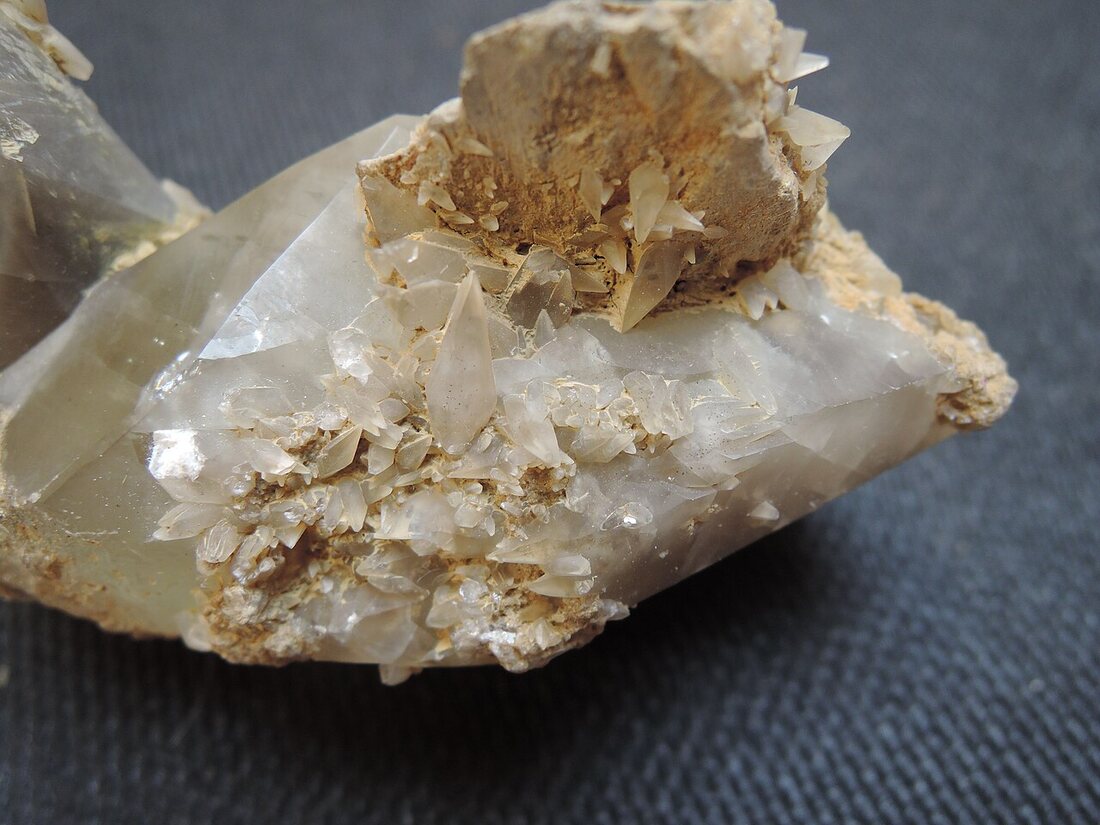
Handling Selenite and Gypsum Specimens Correctly
Handle selenite with clean, dry hands, or thin cotton gloves if you are moving a particularly fine or oily-prone piece, since skin oils can attract dust over time and a hardness of 2 means even light abrasive contact leaves a mark. Always lift and support a specimen from its base or matrix rather than gripping an individual blade or point — a grip that would be perfectly safe on a chunk of quartz can snap a selenite terminal cleanly along its cleavage plane. Two hands are better than one for anything larger than a thumbnail-sized piece, with one hand supporting the base and the other stabilising from the side rather than the top.
Move specimens one at a time, never stacked or nested together, since gypsum-on-gypsum contact concentrates pressure precisely where cleavage is weakest. When packing a selenite piece for transit, wrap it loosely in acid-free tissue rather than pressing bubble wrap directly against a crystal face, and always cushion it inside a rigid box rather than a soft bag, exactly the standard every specimen we sell travels under, tracked and insured, as described in our shipping and returns policy.
Mounting, Stands and Safe Display
Display stands should support weight, not squeeze it. Custom-cut acrylic risers, sized to the specific contours of a piece, spread load safely across a broad area of contact rather than concentrating it at a few points, and are far preferable to metal clips, spring-loaded stands, or anything that pinches a crystal edge to hold it upright. Avoid permanent or semi-permanent adhesives directly on the mineral surface; if a piece needs to be fixed in place at all, a small amount of removable museum wax applied to the stand, not the specimen, is the safer choice, reserved for sturdy pieces rather than delicate blades.
Cabinet or case display, ideally behind glass, protects against the two most common causes of damage in a home setting: accidental knocks from foot traffic or pets, and the slow accumulation of dust that eventually requires cleaning in the first place. Our broader guide to displaying mineral specimens at home covers placement and lighting in more depth, including how designing with minerals as statement stones works for larger interior pieces; for a room built specifically around a large selenite or crystal feature, our interior spaces portfolio shows how collectors and designers have handled scale safely, including how to choose a piece robust enough to travel to a new home without incident as a gift.
Humidity, Temperature and Light in the Display Environment
Gypsum’s water content is locked into its crystal structure as two molecules of water per formula unit, and while that structure is stable across ordinary indoor humidity and temperature ranges, it is not indifferent to extremes. Very low, prolonged humidity combined with heat — a shelf directly above a radiator, for instance, or a sun-baked windowsill — can, over years, contribute to slow surface crazing or a subtle loss of the crisp transparency selenite is prized for, since sustained heat pushes the mineral chemistry slowly toward its dehydrated relatives, bassanite and anhydrite, even though full conversion normally requires temperatures well above anything found in a home. Rapid swings between humid and very dry conditions are more immediately risky than a stable environment at either extreme, since repeated expansion and contraction stresses the existing cleavage planes and can open hairline cracks that were not visible before.
Direct, prolonged sunlight is worth avoiding for practical rather than chemical reasons: heat build-up on a windowsill accelerates the temperature and humidity swings described above, and satin spar’s silky chatoyance can appear to dull slightly under intense, sustained UV over years, an effect more about surface weathering than any dramatic colour change. A stable interior room, out of direct sun and away from heating vents, is by some distance the best environment a selenite specimen can have — considerably more important to its long-term condition than any cleaning routine.
Seasonal humidity swings deserve a specific mention for collectors in climates with hot, dry summers or centrally heated winters, since both push a room toward the low-humidity end of the range where gypsum is more prone to surface stress over years of repeated cycling. Where practical, keeping a display cabinet away from direct airflow from heating and cooling vents does more to stabilise the immediate microclimate around a specimen than any humidity gadget, and it is the same basic principle museums apply when siting gypsum and other sulphate minerals in permanent galleries: consistency matters more than any single target number.
Gypsum Varieties Compared
The table below summarises the main gypsum varieties collectors encounter, alongside representative localities and what to expect from each.
| Variety | Appearance | Representative localities | Collector notes |
|---|---|---|---|
| Selenite | Clear to translucent blades, plates and twinned crystals | Naica, Chihuahua, Mexico; Red River Floodway, Manitoba, Canada | Most prized for transparency; most vulnerable to water and flexing |
| Satin spar | Fibrous, parallel growth, silky chatoyant sheen | Nottinghamshire, England; various Moroccan deposits | Popular polished and carved; avoid dampness across the fibre grain |
| Desert rose | Rosette clusters of curved plates with embedded sand | Sahara region (Tunisia, Algeria, Morocco); Samalayuca, Chihuahua, Mexico | Looks robust but shares gypsum’s low hardness; brush only, never rinse |
| Gypsum flowers | Curling, ribbon-like fibrous cave formations | Karst caves worldwide, including well-documented US examples | Extremely delicate; best displayed undisturbed in a case |
| Alabaster | Fine-grained, massive, opaque to translucent | Volterra, Italy; Nottinghamshire, England | Traditionally carved; still soft and water-sensitive despite the finish |
A Care Do’s and Don’ts Matrix for Selenite
The table below distils the guidance above into a quick-reference matrix for everyday situations.
| Situation | Do | Don’t |
|---|---|---|
| Routine dusting | Use a soft dry brush or blower bulb, working from the base outward | Wipe with a wet cloth or use a feather duster that can catch on edges |
| Fingerprints or grime | Use a barely damp microfibre cloth on sturdy pieces, then dry immediately | Rinse under a tap, soak, or use glass or household cleaning sprays |
| Deeper cleaning needs | Consult a conservator for valuable or already-cracked pieces | Use ultrasonic cleaners, steam, vinegar or acidic solutions |
| Handling | Support from the base with clean, dry hands or cotton gloves | Grip individual blades, points or thin fibrous sections |
| Display placement | Choose a stable interior spot, out of direct sun and away from vents | Place on a sun-baked windowsill or above a radiator |
| Mounting | Use custom acrylic stands that spread contact broadly | Use metal clips, tight-fitting stands or adhesive on the mineral itself |
What Affects Value and Grade in Selenite Specimens
As with any species, condition drives most of the value difference between an ordinary selenite piece and a fine one, and gypsum’s fragility makes that gap wider than usual: undamaged terminations, intact cleavage faces without cloudiness or micro-fractures, and clarity approaching true water-clear transparency are what separate a modest specimen from a genuinely fine one. Size matters too, particularly for dramatic single blades or twinned “swallowtail” crystals, since larger clear selenite naturally survived more handling risk to reach a collection intact, which is part of why exceptional large pieces command a real premium. As we set out more generally in how mineral specimens are graded, repair and restoration should always be disclosed rather than concealed, and gypsum is a species where undisclosed repair is a particular risk, since epoxy-filled cleavage cracks can be difficult to spot without close inspection under raking light or UV.
Locality carries real weight for selenite specifically, given how visually distinctive Naica’s material is compared with more ordinary deposits; a documented Naica crystal of any size is a different proposition from an unattributed generic selenite blade, in much the same way that locality and provenance shape value across most of our collection. For anyone assembling a collection around softer, more delicate species generally, our notes on caring for stibnite’s metallic blades cover a comparably fragile Mohs-2 species with different, but related, handling challenges. When you are ready to browse, our current selenite and gypsum specimens are graded against the same standards described on our grading standards page, with condition notes stated plainly rather than left for you to guess at from a photograph.
The table below sets out the risks that most commonly affect selenite, both before you buy and after a piece is settled into your collection, alongside practical ways to reduce each one.
| Risk | Common cause | How to reduce it |
|---|---|---|
| Surface etching or dulling | Washing, rinsing or wiping with a wet cloth | Dust dry only; treat any water contact as a last resort on sturdy pieces |
| Hidden cleavage cracks | Rough handling, drops, or shipping without rigid, cushioned packaging | Buy from dealers who pack rigidly and disclose visible cracks under raking light |
| Snapped terminations or blades | Gripping a point or thin blade directly when lifting a piece | Always support from the base with two hands, never by a projecting crystal |
| Slow surface crazing | Long-term heat and humidity extremes, such as radiators or sun-baked sills | Display in a stable interior spot away from vents, windows and direct sun |
| Undisclosed repair | Concealed epoxy or adhesive on broken blades, points or clusters | Ask for a condition report and inspect under UV or strong raking light before buying |
Frequently asked
- Can you wash a selenite crystal?
- No. Gypsum, the mineral selenite belongs to, is measurably soluble in water at roughly 2.0-2.5 grams per litre at room temperature. Washing, soaking or rinsing under a tap will gradually dull sharp edges and etch polished cleavage faces, and the damage cannot be reversed by drying the piece afterwards.
- Why is selenite so fragile compared to other crystals?
- Selenite is gypsum, which sits at Mohs hardness 2, the softest common reference point on the Mohs scale, and has a perfect cleavage plane that splits it into thin sheets under pressure. That combination of low hardness and easy cleavage makes it far more vulnerable to scratching and cracking than harder species like quartz.
- What is the difference between selenite and satin spar?
- Both are the gypsum variety, chemically identical. Selenite refers to clear, glassy crystals and cleavage plates, while satin spar is a fibrous, parallel-growth form with a silky, chatoyant sheen, usually white or pale pink. Desert rose and gypsum flowers are further gypsum varieties with distinctly different growth habits.
- How were the giant selenite crystals at Naica formed?
- The Naica Mine's Cave of Crystals, in Chihuahua, Mexico, formed when a deep magmatic body kept groundwater at a stable 54-58u00b0C for hundreds of thousands of years, right at the boundary where gypsum is the stable phase in solution. That uninterrupted, submerged stability let crystals grow to over 11 metres long.
- Is it safe to display selenite in sunlight?
- Prolonged direct sunlight is best avoided, mainly because it drives heat and humidity swings that stress gypsum's cleavage planes over years, and can dull satin spar's chatoyant sheen. A stable interior spot, away from windows and heating vents, protects a selenite specimen far more than any cleaning routine could.
- How do you clean dust off a selenite specimen safely?
- Use a soft, dry artist's brush or a rubber blower bulb, working from the base outward and never dragging bristles across thin blade tips. Compressed air in short bursts can help in a cluster's crevices. Avoid water, ultrasonic cleaners and household sprays entirely, since gypsum is soluble and easily etched.
- Mindat.org — mineral & locality database
- International Mineralogical Association (IMA)
- Mineralogical Society of America
Mineralogical data (species, hardness, locality) cross-referenced against Mindat and IMA records.